Showing posts with label anti poverty. Show all posts

Tuesday, October 25, 2022

Food security? Small and slow solutions

 Spring has arrived and we are as busy as can be, whenever the weather is good. With drier weather, and occasional warm days, we are feeling the need to get stuck into some jobs which always come around in spring. With our Australian economy dealing with global energy spikes  and the poor farmers of the eastern states being flooded -some for the second or third time this year, our fruit and vegetable prices have gone up by 14% this year. 


DH renewed the oil on the outdoor furniture. This is a preservative and it gives us a chance to make sure the furniture can stand another year of outdoor living. 

The garden is busy! We flushed the reticulation pipes and repaired the spots that had got broken since it was last used. The reticulation is now on again, two days a week. Our gardens have to be hardy in this climate! I water pots if they need it, and about once a week I water the non-irrigated front verge if anything is looking distressed. The plants out there are chosen for their ability to survive once they have had their first summer in the ground. 

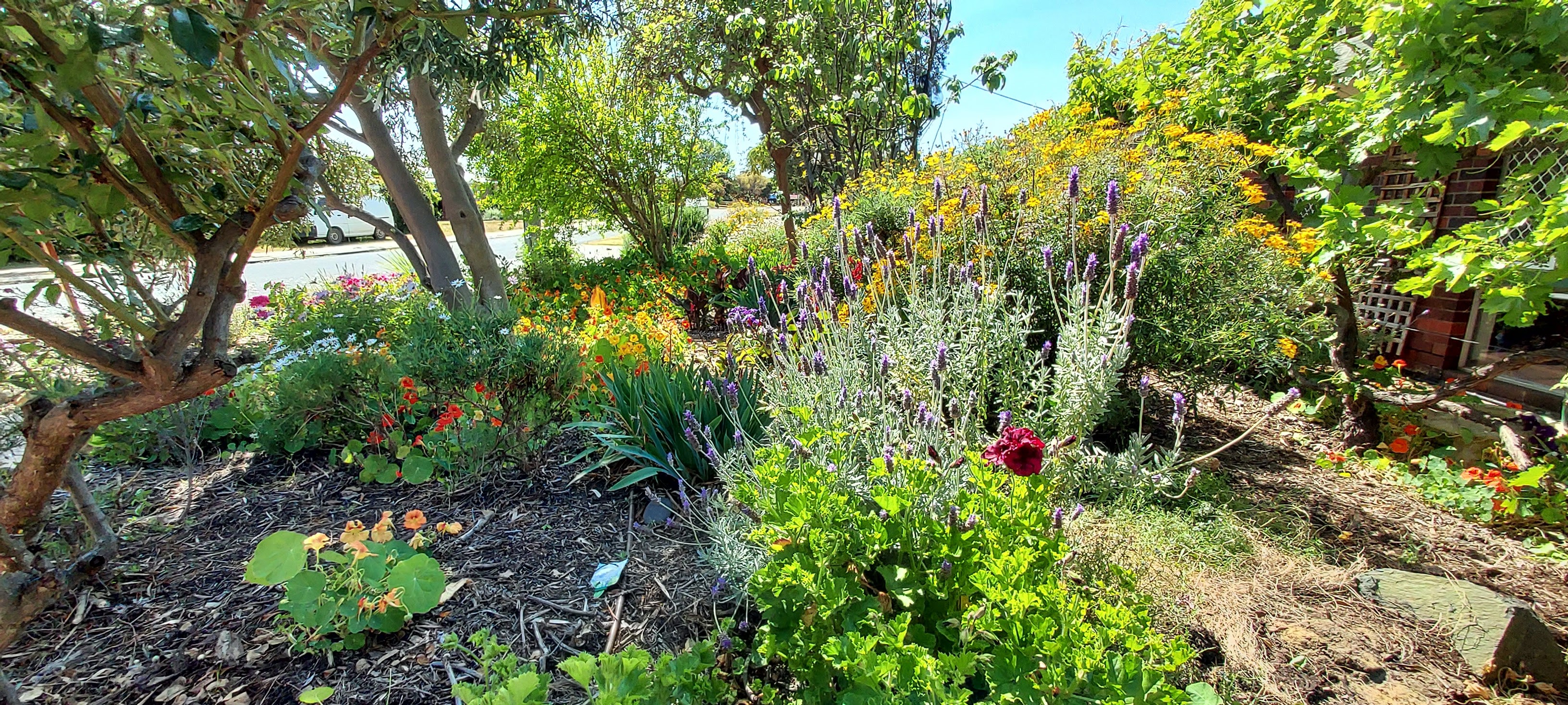
As the annuals in the front garden start to dry off, I am planting perennials like pelargoniums in their place. I have dug up some iris corms and replanted them in other spots. There is warrigal greens ( a native edible)  growing as a ground cover in the front garden too. This garden is both a food garden and an ornamental one. We have a pomegranate, olive, mulberry, lemon and two grapevines here. Tomatoes come up in the compost and I let them grow. Maybe in the future I will be wanting to grow more food out here too. Pumpkins could ramble along under the trees. 


As herbs and flowers are in their prime now, I am drying some and also making sure I leave some to go to seed. I have coriander hanging up to dry, to harvest the seeds for my curries. Lavender is drying to perfume new heat packs which I will stuff with rice.  Mint is known as a good help for digestion and can be good for the brain too, I understand. These may be small harvests, but they are very welcome in my kitchen. Calendula petals can be in a healing salve or tea, or added to risotto. 

 I find herbs to be a very worthwhile group of plants to grow. They are expensive to buy in the shops when you just need a bit for a recipe, but most are very hardy in the garden. Once you have planted them you have fresh herbs for a long time, and they really make a difference to the flavour of the dish you are making. Many of them contain important nutrients too. Herbs I grow include  Basil, Borage, Calendula, Chilli, Chives, Coriander, Curry Leaf, Lavender, Lemon Balm, Lemon Grass, Mint (four varieties), Parsley, Rosemary, Sage, Thyme -2 varieties, Verbeena. Most of these grow easily from cuttings so I can give them away for other gardeners to enjoy. 


Mizuna and blueberries 


The garden bed which lines the fence near the driveway is an important garden space. Here I have curry leaf, rhubarb, blueberries and chilli. 

I have planted tomatoes in all sorts of places and I am experimenting with various kinds of supports and feeding regimes. Nearly everyone says that you should not 'over feed' tomatoes in case you just get leaves and not fruit. Jackie French, the Australian gardener, novelist and all round nice person, says the opposite, so I am trying that out in one pot by adding compost and lots of mulch around a cherry tomato plant. 

We are picking asparagus and rainbow chard and cherry tomatoes. The blueberries are a few days off ripening. I had a lovely big handful of rhubarb with bright red stems from my oldest pot this week. 


There is a mulberry tree on the verge near a park in our suburb. DH brought home half a kilo of ripe berries from his walk today! This is very welcome, as my new FODMAP friendly diet requires me to eliminate some common fruits, but the good news is that berries are fine! My grandson had his first ever mulberry today, and announced that he loved them- and why not? As an urban forager, we know that the polite thing to do is to always leave some for the next person who comes along. Meanwhile our own mulberries are weeks away from being ripe. 


This week we will be helping our grandson plant carrots, sweet potato and snow peas at his place.
In the kindy garden where I am a volunteer, we have rainbow chard, rhubarb and strawberries. 
I love helping people discover the joys of growing a little something edible, and hope to inspire a long lasting journey into growing some food to improve food security.
I am also supporting a little "street pantry" where the community leaves food for others, no questions asked.

A lot of people in Australia are food insecure. There have even been cases of scurvy and malnutrition. I would like to think that those who can squeeze a jar of soy bean sprouts onto their window sill in the kitchen, or a pot with rosemary or parsley on the balcony, would be able to get just a small amount of extra nutrition as a result. It is not necessary to use a lot of money to do this -you can grow things in old tins and styrofoam boxes, and just straight in the earth. Compost can be made in a bin or a bag or a bucket with an old house tile as a lid, and compost is what most plants want to grow in.

The only way for people to be food secure would be for the rate of social security to be raised substantially -but that is sadly, unlikely to happen this year. 

Inspiration for hard times: simple ways to garden without spending lots of money  

Make a wild food map of your area here 

Food insecurity in Australia -read here 

Friday, May 6, 2022

Inflation -some strategies for avoiding spending money


 In Australia, as in other places, the cost of living is rising sharply at the moment. Interest rates are going up, and for those who have loans and mortgages that means that they will have less discretionary spending money.

Food prices are going up around the world, too. 

One of the best definitions of inflation, that I have read, is 'a time when your money buys less than it did before". For anyone on a tight budget, or a fixed income, inflation is a challenge -how manage when prices are going up? What follows are my thoughts on how someone in my situation -one a fixed budget and at the retired stage of life, might do some hedging against price shocks.

  NOTE: I know many others have it much tougher than we do, and I am sorry, really sorry. If this blog post is not helpful because you just don't have enough money now let alone when prices go up, please know that I have been there too, and I really hope our society can be kinder and fairer to everyone. In Australia that means, at the very least, we should raise the rate of Newstart to something like $80 per day. 

Get it for free

This is a devil's ivy plant, which was given away on our local "Buy Nothing"  site, because it really really needed some plant first aid. Now, I have quite a collection of indoor plants, and enjoy growing them up. They can cost quite a few dollars, but last a long time if cared for and in the right place. 


After a few weeks of tender care the plant is now thriving in a new pot -this one which actually has drainage- and I am using the pot as a cover pot for another of my plants. It was a fun challenge, and it made me happy. If I want to, I can now give it away as a gift.  Free stuff -you might find it in all sorts of places if you are open to it. It is particularly true in gardening -most people are very happy to give away cuttings and seeds, or even whole plants if it is in the wrong place, and you are willing to dig it up for them. Many of my garden plants were grown from cuttings, and often turn out to be the best for this climate, such as pelargoniums and shasta daisies. 


I will also mention libraries as my favourite place to get reading material for free. I absolutely love my library -I am an avid reader. It would cost a fortune to keep me in books, so libraries are a great source of entertainment and education and they cost nothing. 

Books to find at the library on frugal living
The Art of Frugal Hedonism bu Annie Raiser Rowland and Adam Grubb

A Girl Called Jack -recipe book for those who are living in a low cash environment -and all the other cook books Jack Munroe has authored, like "Cooking on a bootstrap" and The Tin Can Cook. 

Regarding free stuff -it may be important to check what subscription items are in your budget that you could replace for free things -I am thinking of subscriptions to various apps and channels. If we are creative, we can find our entertainment and educationw without paying each month for it. 

Lend it

If you can't get it for free -maybe you know someone who would lend you something you only need for a little while. I read somewhere that most electric drills are used for only 4 hours. People want it to do one thing, buy it and never use it again. In some parts of Australia folk have set up lending libraries of things like camping equipment, garden and workshop tools and the kind of things you need for a big party, but don't need very often. If you take good care of the item you borrow, and return it on time, you will keep your friend happy.
Don't forget to return the favour -maybe you have some things you could lend to another. The kind of reciprocity of this exchange builds community. 

Maintenance Pays Off

We have all had that experience of suddenly discovering that the washing machine won't work, or the dishwasher is making odd noises, or the car has a warning light on the dashboard. Not only is it often extremely inconvenient, it is also really expensive. Getting a tradie to visit your home involves a 'call out fee' even before they have started work. 

I try to do routine maintenance on my appliances to ensure that they last as long as possible, and that such emergency service calls are only required infrequently. I am not in any way a technical or mechanically minded person, but I can easily clean the filter on the dishwasher, and often give it an extra clean with lemon juice or vinegar, to clean off scale and mould in the pipes and hoses.  One of my friend's adult daughters watched some YouTube videos before succesfully fixing their washing machine. 

My car does get it's regular service, and now that we use a mobile mechanic who comes to our home, we notice that they do not try as much as the franchise mechanic, to on-sell us extra parts like air filters.

Cleaning out the gutters before the winter rains is a good maintenance tip. Water in the roof can be really expensive to fix. 

If you can sew, a bit of repair on a hem or a button can save money on buying another item of clothing. 

If you have your appliance handbook, there may be some tips about regular maintenance and what to do if it stops working. I have mine in plastic pockets in a lever arch folder, and this has saved the day many times. Like the time we somehow put the child lock on the induction cook top -and nothing worked. before panic set in completely, we remembered the manual, which  told us how to fix it, without a call out fee! 

Plan for replacement -or do without

We are using YNAB for our budgetting, and I love it. One of its rules is that a good budget knows the difference between an emergency and a 'true expense'. True expenses are things like buying new tires for the car -usually not an emergency, we should be able to predict that we will have to do this at least months if not years in advance. Similarly, we should be able to predict that a 7 year old appliance is probably going to need replacing sometime in the next year or so. If we set aside small amounts regulary to cover such replacements, we should not have our budget wiped out by them. In fact, if it works well, we just pay it! No drama at all! 

Of course, if there are too many things which need replacing all at once, before the budget has enought in it, we might be in difficulty. At such times we might just have to get by without the appliance for a time. In an inflationary environment, it will possibly be much more expensive to replace our appliances than when we bought them some time ago, and so knowing how to do without for a time, is a really good strategy. I know that I can wash all the dishes by hand, even though I would rather not, but I would struggle to wash clothes by hand so I would priorities a washing machine over a dishwasher if it had to be one or the other. 

Of course, you can budget this way without YNAB -we did for years with a spreadsheet, but the idea of true expenses is important to know. 

Do It Yourself

Some years ago I was part of a website and forum which taught frugality. One of the people there was a woman who had suffered an injury at work and so was unable to contribute cash to her family by paid work. She worked hard on finding ways to replace the things they had bought with cash, with things she could make using the time she had once traded for dollars at work. If she had been used to purchasing a packet of biscuits, for example, she made biscuits. If they were used to buying soap powder, she made her own. She actually went to the shop, studied the list of ingredients, went home and researched and experimented to find replacements. If you have the time to give, you can replace many consumer and manufactured products with your own ready made items, at cheaper cost, without fancy packaging, shelf stabilisers and funny ingredients. 

You can make your own curry powder, grow your own herbs, bake your own bread, culture your own yoghurt and make clothes. I learned a lot from this woman's example, and now have many items we regularly make ourselves.


In the garden I make compost, which uses up things we would otherwise throw away, and get a soil amendment to help me grow fruit and vegetables which saves me money too. Our worm farm makes the best soil amendments. Sometimes I simply take the 'do nothing' approach -if the plant is a bit sick, and I have watered it and fed it, and it still has problems I wait to see if the ecological niche it lives in will support it or whether it was just wrong for this place. I don't buy poisons and amendments for the garden. 


DH is a handy person who has helped us a lot by putting up shelves, painting walls, making and repairing furniture, repairing loose screws and such. Often a simple tool kit, picked up cheaply in garage sales, can make a big difference-every house should have a screw driver or three, a hammer and a pair of pliers. Dh often recycles things we get for free from our local Buy Nothing group, or cheaply from the Tip Shop. These lovely windows came from a neighbour for nothing.


Just today he replaced a towel rail in the main bathroom, which had actually broken off at the part where the rail joins the supporting plate attached to the wall. Imagine if we had to get a tradie in to do that job -it would have taken a lot more than the $70 for the new rail.


Don't forget to Pay it Forward

If the times are bad, our community can be a powerful force for good. It is hard to face hard times alone, so if we can, we should offer our surplus to others. This is a basket of limes from my tree which I have put near the letterbox for others to take.


If we have free time we can volunteer at a community organisation -it costs nothing, but can be very rewarding. If we are living in a tight economic environment, and feeling pinched, giving back to the community by volunteering might be something which gives us a feeling of bounty, of abundance and of connection. Both DH and I volunteer in community organisations and we love it. He is treasurer of a mediation community and I work in the garden of a play centre. 

Finally my advice is to try to be content with things -and here is a small article which may assist 

Home renovation of a modest budget


Saturday, August 3, 2019

Retrosuburbia Conference in Fremantle

DH and I were excited to attend the Retrosuburbia Conference in Fremantle on Saturday 3rd August, even though it meant being on the local railway station at  8 am! We joined over 200 like minded people who wanted to hear the author of Retrosuburbia, David Holmgren (co-founder of Perrmaculture!) speak about this wonderful book. 


"RetroSuburbia is part manual and part manifesto. The book shows how Australian suburbs can be transformed to become productive and resilient in an energy descent future. It focuses on what can be done by an individual at the household level (rather than community or government levels)". 

.DH has heard me talking about the concepts and helped me put some of them into practice, but hasn't been able to attend a meeting. Now he is retired so off we went! DH was very impressed with the "Aussie Street" story that David presented.


If you click on the link below you will learn a lot more about this inspirational book.  


A great part of the day was given over to discussion groups on any topic at all which a group of people wanted to discuss together.


  • I learned from people who had established verge gardens (do you call them nature strips?) -what works and what problems might occur, especially with council regulations here in the city. I have been thinking about removing some of the brick paving we put down years ago, so I can plant native plants to encourage the wildlife around here.
  • There was a good discussion of bartering: how to do it, what sometimes goes wrong.
  • I attended a group which wanted to talk about rescuing building material from skip bins! 
  • DH went to a discussion on the humane management of bees. 


The lunches and morning tea were all brought by the participants. You can imagine that the fare was really wonderful and we were very well fed. A bunch of happy volunteers attended to help with the logistics. We were modelling the kind of community spirit which Retrosuburbia advocates!

We met a number of people from my side of Perth. Did you know that Perth is divided by the Swan River -and in our minds- as North and South? The city spreads a long way in both directions, so it was especially pleasing to finally identify the "Northern Permies" group.


Community was also big in another way this week around here. Our local Street Pantry was the part of a story on the needs of the community, on one of the local TV stations current affairs shows. The pantry shelves were a bit bare, so one of our admins put out a shout for more donations, and people turned up with donations in response. I went down with a basket, hoping to get in and out before the cameras arrived, but they TV crew turned up as I got there. I ended up being filmed putting donations on the shelves. Here are the shelves as of today: much less full than on TV. We have a lot of need in our communities for people who 'run out of money before they run out of month" and whatever comes in to the pantry goes out again pretty quickly. The way our Government has failed to heed the calls to #RaiseTheRate of Newstart is putting huge pressure on people who are already struggling.

Apart from all of these exciting things, I have been spreading mulch on my garden beds. This is quite a workout, and I have been feeling it a bit as I climb into bed.
DH has a wood project which he has been working on, and we hope to tell you about when it is finished in a week or so.
I have also been unpicking seams on the quilt blocks I have been given. I have decided on a setting, and will be gradually working on adding sashing strips to the quilt blocks.

So, I am off now to get into the kitchen and do some preparation for the week.

Thanks so much for stopping by and reading my blog post today!


Sunday, March 31, 2019

How to shop for food -tricks and tips that the supermarkets don't want you to know

I was speaking with friends this week, about our Greenwood Fresh Food pantry and the challenge of feeding a family on a very limited income which one of them was doing for Lent, and it got me thinking about the strategies I use for shopping for food which may not be known by everyone, but which I have found out through the very generous people who are part of the Simple Living community. It is turning into quite a long post! Maybe you need to get a beverage of choice and read along.

Inspired by people like Rhonda Hertzel and her book The Simple Home, most of us who have taken on the Simple Living approach know that we can feed ourselves well -and more cheaply -if we do most of the cooking for ourselves. We get to choose the ingredients, we get to manage portion size, and we have control over freshness and can limit waste. By feeding ourselves well for less, we reduce our demands on paid work to raise income, we reduce our demands on this overburdened environment, and we give ourselves and our families the best start for good health. We become self reliant -able to manage this important task without being dependent on outside help.

So here are my top shopping tips which the supermarkets don't want you to know:

 The cheapest, freshest staples are found by 'shopping the walls'. Think where the meat fridges, the fruit and vegetables are -around the perimeter of the shop. Walk around the perimeter first, and put most of your grocery spend in the basket from these places.

Buy food in season. Sure, they can import Californian oranges when our Australian orange season is over, but they are expensive...and a bit tired after a huge journey. Just imagine the carbon miles clocking up with these! The supermarkets want us to think any food is available to us at any time of the year, but that comes at a cost to our food budget and the environment. The best way to know what is in season is to leave the supermarket and go to a farmer's market -you will soon find that the foods in season are cheap and plentiful there. At the time I am writing this, it is early autumn in Perth and the farmers are over-supplied with zucchini -and offering packages like "Buy 3 for $2" -huge trombones of zucchini!. You can grate and freeze zucchini for later. This goes for other fruit and vegetables too. Leave the out of season, imported fruit on the shelf -when our own local season comes in, enjoy it to the full! This variety of foods is what makes our year interesting, and nutritionally sound.

Look high, look low. The foods which the supermarket wants you to find easily are in the eye-level shelves, where they stack the processed and packaged foods. Look up or down to find things like -dried beans, those power houses of protein and fibre, which are easy to prepare in bulk and freeze for chucking into soups and stews and salads. You will also find lentils and dried split peas there.

Keep at track of the price cycle. Most Australians are used to seeing the price of petrol go up and down according to the weird marketing cycle we have here, which sees prices jump just before a long weekend, and go down on Mondays or Tuesdays. DH subscribes to a government sponsored price watch service, which tells him where the cheapest petrol is on a daily basis. The same thing happens in supermarkets, where the price of something like coffee can be as much as $25 per kilo or as low as $15 a kilo, depending on the 'specials' they offer to get you in the store. You want to try to buy at the lowest point in the cycle, which means buying enough to last through the rises, until the price comes down again. I try to have at least one backup of every staple in the cupboard : 'one open, one on the shelf".

Some people recommend keeping a 'price book' in your handbag, where you note the date and place of things you buy often, so you can keep track of prices. I have to admit I haven't ever done this for long, but it is very instructive even if only done for a week or two.

Don't shop so often Every time we go into the supermarket, they tempt us with things that we didn't have on our shopping list (you do shop with one of these, don't you?) and we spend more than we planned. One of the ways to 'send the supermarkets broke" is to shop less often. You can do this by building up a store cupboard of food at home which means you always have something to cook and make a meal with, so you don't shop so often. When building your supplies, you buy at the cheapest part of the cycle for each item, you buy a number of them, and you make sure that you use them in the time when they are freshest.

Buy in bulk It is worth my DIL to travel an hour away from her regional shopping centre, to buy in a place where food is cheaper, and access to bulk supplies is possible. I am lucky - I have access to a warehouse type bulk food shop because of my RAC membership and it is 5 minutes from home. This shop is a bit like Costco but without a membership fee. I buy 'slabs' of 12 tins of Australian tomatoes, or 5k of bread flour, or a box of 24 tins of cat food. Rice is cheaper per serve when bought in big bags.  Some of these things I will immediately decant and freeze to protect their shelf life -bread flour lives in my fridge, for example, in the garage. You can put the bulk supplies in your pantry with a little bit of creative stacking, or slide a box under the bed or on top of a wardrobe! I had a cupboard which once stored an indoor water heater. When we moved the water heater to the roof we had a space which DH built shelves into, so I have both a pantry and a larder for long term storage!

Grow it yourself There are 'living herbs' for sale in supermarkets -you buy a little pot of basil, for example, for about $3. If you take the plant out of the pot and carefully tease apart the plants, you usually find there are actually about 4 plants which you can pot up and grow on. I have about 6 basil plants which have grown all summer from such a pot that I got from a supermarket.

Fresh sprouts like bean sprouts are expensive and can quickly spoil, but it is easy to sprout your own in jar on the window sill, with minimum effort and maximum nutrition.

If you have a balcony or courtyard you can fit quite a lot of food grown in pots. I would grow herbs everywhere I lived, just because they are packed with nutrition and they make food taste great, and are pretty tough. They are also expensive to buy! I grow some food in styrofoam boxes I got free from the supermarket- they were used to ship broccoli in.


If you have more time and some garden available, growing cut-and-come-again lettuces, silverbeet and spinach is easy and quick. I have just harvested some sweet potatoes from my garden. I also have a lot of fruit trees: lemons, limes, grapefruit, mandarins, quinces, pomegranates, olives, mulberries, cumquats, blueberries. You have to be prepared to deal with the harvest when it comes, though! This is where the skills of dehydrating, freezing and bottling (canning in the US) come in handy.


Make it yourself.  If there is a regular 'packet' of something which you buy for a recipe, chances are that you can make it yourself and it will be cheaper and won't have corn syrup or fillers and thickeners in it. What I do is start by looking at the list of ingredients on the back of the packet to see what the main components are. For example, we make a mince and cabbage dish which I used to buy 'french onion soup' mix for. I have been able to make a very acceptable alternative with dried onion flakes and chicken stock powder. Here is a recipe if you need it. You could make a jar full!

I make a Sri Lankan curry mix which my family love.

Other mixes I make are things like 'cream of anything soup mix' like this one. Home made sausage rolls are a revelation! They only take a couple of squares of puff pastry and a pack of sausage meat or mince -and you can make big, fat sausage rolls at a fraction of the supermarket price.

About eight years ago, I was given a bread making machine from a relative, and I started   making bread with packet mixes. It was cheaper than all but the most generic loaves, and I started to get the experience to try making it from scratch. Now I use a stand mixer to make my bread, and mostly make sour dough loaves. My loaves cost me about $2 but an artisan sour dough loaf of similar size is at least $6. I enjoy the growing sense of competence I am gaining, so much so that I am expanding my repertoire to learning to make pastry from scratch too.


I also make our soap powder for the washing machine: see here for a recipe. We have got used to fragrance free laundry, so much so that if we are on holiday and using a laundromat with a bought powder, we notice how strong the smell is!

DH makes jams and chutneys, and takes responsibility for making our yoghurt using UHT milk and full cream milk powder.

Substitute expensive ingredients for cheaper ones  I have a number of cook books, and regularly get others from the library which I read avidly. From this research I know that you can make a very acceptable hummus with peanut butter rather than tahini, that you don't need basil and pine nuts to make pesto but that a herb like parsley or mint will do, along with just about any nuts you have on hand. The queen of recipe substitution is Jack Munro . I recommend you get a book of hers from the library-it will be a revelation! Frozen berries are cheaper per kilo than fresh ones, and whilst I love fresh fish, it is often much cheaper frozen. DH quite likes soda water in the hot weather, so I gave him a soda syphon so he can make it more cheaply.

Use less  You don't need to 'rinse and repeat' you shampoo -in fact, you can wash your hair quite well with soap! You don't need bread flour to make bread, if ordinary flour is available, it will make  a satisfactory loaf -or make a 50/50 mix of bread flour and ordinary plain flour.  You can make a second cup of coffee from the grounds left in the french press after the first pour -particularly if you are making iced coffee for hot weather drinks. You can dilute hand wash for the bathrooms and people will still get plenty of lather for their handwashing. Many cakes will be perfectly OK with less sugar in them than the recipe says to use. We can eat less meat -serve smaller portions, add other ingredients to it to 'bulk' it out. Many nations have learned to have wonderful, tasty vegetarian and vegan meals or to serve meat as a condiment rather than the main item on a plate.

Don't buy it at all! In moderation it is nice to have luxuries, but nutritionally we are really better off with water than soft drinks (soda in the US) or bottled fruit juices. We CAN actually go without coffee if the budget is tight, although I would probably have a riot on my hands if I suggested that here. In fact, I love my coffee. If we were struggling, though, I would definitely cut down the number of cups per day, and always make it at home. I am afraid alcohol comes into the discretionary category too...lots of calories and lots of money. At least we can moderate our consumption -leaving the wine etc to one or two days per week will help. You can cook with cheap wine -don't listen to the posh chefs who insist otherwise.

We CAN manage without any special cleaners in spray bottles -vinegar and dish soap and bicarb soda can do any job around the home we need, pretty much. Did you know that when Choice Magazine tested laundry pre-soaker stain removers, some of them were not rated as effective as plain water? You can also get a good result from water and your ordinary laundry soap.

Shop somewhere else There are great bargains to be had in independent grocers, especially those who cater for the ethnic communities of our cities. You can buy large bags of spices instead of tiny bottles, and they are fresher too. Bulk goods are available. We are lucky that we have a big variety of these independent and ethnic based food sources -but you can also find ingredients like these online.

Beware the back of the fridge left overs! I love leftovers- my family sees them as a great bonus. The thing is, there is no point in shoving leftovers in a container and then throwing it out a week or so later. A label is a wonderful thing to help get the leftovers used up- especially if you put the container in the freezer! I once took cumquat pulp to work for lunch, thinking it was pumpkin soup! Now I am getting more determined about labels! I have used a roll of painter's masking tape and a permanent marker to label things -and also my fancy label maker gets used too. Leftovers can be dumped into 'weekend soup'- that soup I make where I get all the tired looking vegetables chopped up and added to a big pot, along with any leftovers of stew, curry or similar. Each soup is a wonderful, original recipe! Weekend soup makes great lunches for the week, before I head out to restock my fridge in quieter shops once the working week starts again. Leftovers can be made into pies when added to ramekins or dishes topped with mashed potato or pastry and heated in the oven. They can be added to toasted sandwiches too.

We need to reduce food waste -Australians are said to waste $8 billion worth of food each year!  That averages to about $1000 per family, which is enough to pay for a lot of  power bills! Storing food correctly is part of the answer, but we also need to plan  our menus around the need to use up the food we buy, and not buy more than we can use. I also try to use up as much of the food as possible -broccoli stems are just as good as the florets, for example. I compost our waste in order to grow more food. One good idea is to peel and chop vegetables in batches so that they are ready prepared and easy to use. My new fridge has puzzled me for a bit -the crisper drawers are not keeping things as crisp as my old one did! However I am now chopping the veg and putting them in plastic containers to keep them crisp and to take up less space.

Learn about how much of the plant you can eat, from studying the food habits of other countries. Grape vine leaves are used in Greece to make dolomades -you can even buy them in packets! Maybe you have a neighbour who will give you some, if you don't have your own. Just make sure they haven't been sprayed though. You can put nasturtium leaves and flowers in salads, and if you invest in just one packet of seeds you will probably have them in your garden for ever. You can eat the tips of sweet potato vines too. I used to cut off the base and the leaves of celery and put them in the compost, now I know that celery leaves can be added to salads and soups, and that the base, if popped onto damp soil, will grow a new plant.

Get a quick meal plan We all get tired sometimes and don't feel like faffing with a recipe but we are hungry. In these circumstances we need a selection of things in the freezer we can pull out and serve quickly, along with a selection of quick recipes which can be thrown together in the time it takes to order pizza. Puttanesca pasta is one such recipe we often use -made with store cupboard ingredients of anchovies, tinned tomatoes and olives along with dried pasta. We love 'breakfast for dinner' such as fried eggs, tomatoes and a tin of beans with toast!

If you have made it to the bottom of this post -thanks for sticking with me. I would love to hear from you if you have tips not mentioned here -we could assist each other to make a comprehensive list!

Friday, October 19, 2018

Raising my voice


This is Anti Poverty Week, and so I went along to the rally in the city of Perth. I see this as part of my Simple Living practice: to engage with the community in ways to improve our lives together. If I want my life to be sustainable and simple I am sure the answer lies in assisting positive social change for all. I am not living this life in isolation. 

It is shocking that inequality is growing around the world. In Australia it is fueled by the lack of entry level jobs, wage stagnation and the fact that the Newstart allowance given to job seekers has not increased for 25 years.

There is an increasing tendency to blame the poor for their situation, instead of seeing it in structural terms. We can fix poverty by doing several basic things: raising Newstart, creating more social housing and ending the scandalous Robodebt fiasco, where welfare recipients are being forced to defend themselves from paying fake debts to Centrelink. It is estimated at least 1 in 6 is fake or needs to be corrected.  Then there is the punitive use of Cashless Welfare Cards, to stigmatise welfare recipients and take away their agency to make decisions about their use of welfare support.

Here is the St Vincent de Paul statement about the Cashless Welfare Card:  St Vincent de Paul Society does not support the cashless welfare card. There is no evidence it improves the wellbeing of individuals or communities, either by reducing substance abuse or by increasing employment outcomes. The cashless welfare card also carries a high risk of unintended and expensive consequences across government and the community, including social exclusion and stigmatisation, increased financial hardship, and the erosion of individual autonomy and dignity. Ultimately, this is a punitive and paternalistic measure that is driven by ideology rather than evidence.Find more here 


There was a major rally to call for a total ban on fracking non-conventional gas in Western Australia.  I went to that one, too! We are worried about the impact of fracking on our natural environment, particularly on our water supplies. 


The final thing I did in a fortnight of raising my voice was that I attended my local City of Joondalup council meeting, to assist with a campaign to get them to consider divesting from fossil fuels.  The group I went with comes from 350.org Perth. we are building the Divestment movement and resisting new fossil fuel projects to build a broad and effective climate movement powerful enough to create a safe climate future.

This is what I said:

I ask Councillors to support the motion that

"the CEO to prepare a report on the options for the city to change its risk appetite and investment policy to place a greater percentage of invested funds into institutions that have all (or a great majority) of their portfolio in fossil fuel free investments, providing that in so doing the City can secure a rate of return that is at least equal to the alternative offered by other institutions".

Climate change is, as you and I know, one of the challenges facing the City of Joondalup in the future. I refer you to the recently released “Coastal Survey Outcomes Report” which has been considering how our city might respond to the challenges of coastal erosion due to rising sea levels.

I also refer you to the City of Joondalup Environment Plan 2014 to 2019 which has a whole chapter on Climate Change Mitigation. If we are serious about this problem for our City, we won’t be undermining our efforts at reducing waste and supporting local environments by using the City’s assets to invest in industries which will make climate change worse! We can send a clear message to the fossil fuel industry: change your ways now and join us in tackling climate change

As the Mayors of London and New York said on 10th September this year that “We believe that ending institutional investment in companies that extract fossil fuels and contribute directly to climate change can help send a very powerful message that renewables and low-carbon options are the future. If we want to fund the scale of transformation the world needs, we must foster sustainable investment and use the power of institutional investors.”.

Do you get involved with local community actions like this?