Showing posts with label inspiration. Show all posts

Sunday, April 19, 2026

New garden path! Fairy enchanted!


It was a long term plan of mine, to have an informal path under the trees in the front garden, from the letterbox, round the mulberry tree and to the steps under the pergola. The idea was that this path would give definition to the garden beds and keep our feet to the path, where we might be able to move around even in wet weather without getting too muddy. 

I wanted a path that would be relatively cheap and easy for us to put down ourselves. We are in our early 70s and so brick paving is a bit hard on the old knees and not a DIY project.

In the end, we chose a metal corrugated garden edging and a pile of woodchips which we had delivered. 

It took 4 days of activity - about an hour at a time, which was quite enough for a couple of older gardeners like us. DH laid the edging and I did the mulching. 


I have been planting volunteer plants like yarrow and pelargoniums on the garden side of the path and I expect that by next spring the place will look great. 


AND then we added lights!


I am delighted with the results! The wood chips are easy to walk on, and they keep my feet dry when the garden is wet. Each day I walk along the path and pull out any nasturtiums who want to grow in it, but that only takes a moment. The fairy lights give me a little bit of joy every evening. 


Sunday, March 16, 2025

Gardening after a long dry summer -inspiration!


Well, the big news is that it RAINED! So yes, it is officially 'autumn" or actually it is bunuru, the Noongar name for the season where the storms begin and the weather gets a bit cooler - low 30C rather than high 30s-40C-  and the Marri trees are in bloom. We had a fabulous thunderstorm this week and it has made everything greener and more refreshed. 


I harvested the pomegranates, to save what I can of the crop because various birds or rats have been eating them. I took a few to a local food pantry, along with some fresh limes from our tree, and they were well received. Now I need to get the kernels out of these in the bowl, so we can freee them for salads later in the year.


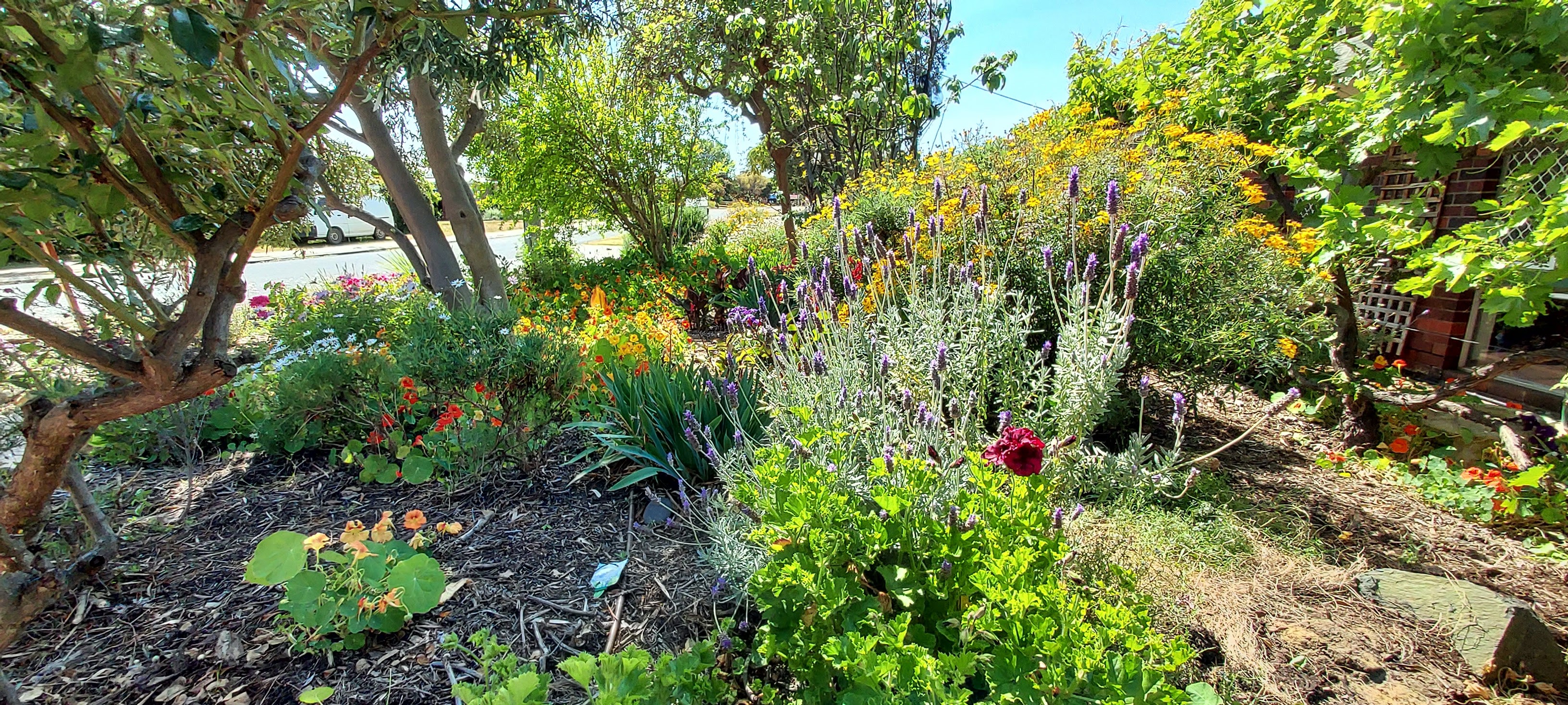
A bit of rain makes Perth gardeners think of planting things! I went to a garden cntre and bought a new hibiscus, some herbs and a salvia for the front garden, which I have been renovating. I have scattered calendula and marigold seeds in there as well. Our rear garden is pretty much given over to the fruit trees and productive raised beds.  The front garden, however, whilst it is wonderful with both fruit and flowers for much of the year, looks pretty drab at the end of summer, as very few plants flower in the heat, and everything is a bit stressed. 

I want to plant things closer together and have more foliage, at the very least.


This is a rose called glamis castle, I think. It is never very abundant in summer, but the spring and autumn suit it better. 

The plants that can take the heat in this climate -frangipani and hibiscus - are going to be featured more. My two white roses are survivors, but they have shown that they just need more water than our drip irrigation, 2 mornings per week as allowed, can deliver if they are going to flower consistently. I have changed the watering delivery method to help support them, along with a bit of handwatering too. 

I have planted an apple blossom hibiscus and a purple one called Hawaiian Skies.

Everyone says that salvia are tough and long-flowering, but I have tried two before, which died. I have a new one, and will take special care of it and hope it becomes established. 

I have put another frangipani in the ground -it was a cutting which I grew on in a pot since last year- and also a lemon verbena which I also had in a pot. 

There will be some lower storey plants -yarrow, iris, pelargoniums, daisies, along with some herbs like thai basil and parsley. I have scattered marigold and calendula seeds.
 
Getting Inspired
There are a couple of places I have found real inspiration recently. One is the wonderful Regenerative Skills podcast, which connects me with a community of permaculturists around the world, who are working in hard conditions, and who often have very few resources.  It is a source of hope.  

Hugh Edward's You Tube channel is also a fantastic resource. I loved the 9 tips one which helped me get on to the job of processing my seed for storage. This picture below is fennel which I had been drying in the laundry. It smells amazing! I have come to really think that fennel is an under appreciated herb. It grows as a perennial, has tall ferny fronds and is so useful in salads and for creating a bed for your roast to sit on in the roasting pan. You can eat the seeds and they germinate well in the garden and will grow without much water. 


I have been letting these self-sown pumpkins run under the citrus trees. There are about 5 which have survived and grown well, but they do try to take over!


The limes are gowing fresh and juicy at the moment. We have mandarins and lemons ripening up too. 

I have some elephant garlic to grow, when the temperatures drop a bit more, and I need to decide on other winter vegetables - we love snow peas so I want a lot of them!

It feels so good to be energised after the hot summer, and I am looking forward to seeing my garden green up soon. 


Saturday, September 21, 2024

How to decorate and refresh without shopping


I love being creative-I quilt, I garden and cook, and I decorate. I love to change things around inside my home -a shelf or  a mantle might get cleaned off and a new collection of items put there to entice the eye and the brain.

As someone who loves living simply, I try to do this without following decorating trends or buying new things. If you can make your house a home even if there is not a lot of money, you are on a budget or just sick of shopping, are there any things you can do to decorate and refresh? 

Well the first thing I try to make myself do is just tidy up!

It always surprising how a clean floor and a bit of dusting and straightening makes everything feel calmer and nicer. The same goes for opening windows to let fresh air inside, and cleaning up pet clutter. The cat tray is a mega issue for my happiness unless it is fresh. I think Dora prefers it that way too! 

I am quite conscious of things which are out of place and find it hard to work or relax in cluttered spaces. This is not true of everyone who lives in my house, but as it bothers me they are usually pretty good at putting things away, and I reckon that if it bothers me and not them, it is up to me to fix it. 

Long time ago I found help from Flylady and her cleaning routines. I actually read her book which I got from the library! We were parents of young children and both had to work long hours. The house was so messy that when we had a break in and the police came, I had to say "No, they didn't trash the place, it always looks like this'. Embarrasing much? 

Flylady mottos and practices are still part of my life. A five minute pickup does make things better. Cleaning your sink and making your bed does calm the space and help you feel in control. "Focus makes you fabulous".  Lately I have found Dana K White's podcast "A Slob Comes Clean" is very useful too. 

Apart from tidying up, which has its own real and cheap magic to perform what can you do?

A LIST OF STRATEGIES

1. Instead of buying cut flowers

If you look at online decorators blogs you will find plants and flowers feature in the inspirational photos. Flowers cheer any space up, but there are only a few times when I am certainly going to spend $35 on a bunch of supermarket flowers. Instead I do the following things:

  • bring in a pot plant for a few days -some of them stay if they like the space, others need a long time outside and a few days inside 


  • cut some green leaves and stick them in a vase or jar or pot or anything. If you have only a few pieces, they can go in a tiny vase or an eggcup or a medicine bottle. 
  • go for a walk and collect some sticks and dead branches or seed heads to spread on a shelf 

  • Use local flowers, seeds and cones that you find in your garden. In Western Australia it is a crime to take these from the bush, but we can have lovely things at home in our garden, like this hardenbergia growing over a stump of a dead tree in my garden. 
  • Make one or more crafted flowers-and have fun at the same time!
  • raid the collection of fake flowers -do you have any? I keep some in the cupboard and mix them up with real leaves -they look more realistic that way. In my climate there are times when flowers are hard to come by in the garden- the height of summer, for example, when the heat browns everything off. Fake flowers or dried flowers can fill a gap -but I don't leave them out until they are dusty! A swish in warm water will revive silk ones, but dried ones need to be taken outside and given a shake. Moving them around makes them feel different too. 
  • Use fruit instead. Bright lemons, green olives in a wooden bowl or basket, anything you have. 


2.  It is dark in here!


Natural light is one of those things that architects get good money for designing into a space. You can't do much if it is dark and dreary outside, or if your house faces to a blank wall, without expensive alterations. Here are some ideas which are cheaper than those major changes:
  • Open the curtains or blinds to the maximum they will go. I am shocked how often people live without even noticing the free light which they could have if only they pushed everything up, away and against the wall. This might include re-arranging furniture to maximise the light from a window. If there is foliage in the way outside, time to prune it down! I don't like furniture to block natural light if it is at all possible to put it somewhere else. 
  • Check where you can encourage light to bounce from outside to inside. We had a dark brown floor on our entry porch, but when we tiled it with left over white tiles, the afternoon sun bounced off the tiles, to the porch ceiling and into our dark loungeroom. It was also safer to come up to the house because the step was easier to see. A colourbond shed in the garden shines light into our kitchen and brightens things out there. 
  • Mirrors can bounce light around -try putting one in a place where it can collect light from a nearby window and push it towards the dark space.
  • Add table lamps -I often get mine from op shops or the tip shop. Maybe add a nice shade if it is worth it. Fitted with a LED globe they are cheap to run.
  • Can you make a colour change to something lighter? Cushions, rugs and curtains are not too hard to move around and some of them can be home made too. They can brighten a space. 
3. I am bored and this place feels tired 


Sometimes I just need novelty! What I do then is fall back on the old 'move things around or shop at home" to make a tablescape. The above is one I made around Halloween -a book I already owned, a couple of lanterns from the garden, a  gargoyle from the op shop and some magpie feathers found in the park. Other ideas include- 
  • move pictures from one room to another 
  • move the furniture around 
  • put music on, open the windows, light a candle
  • Choose a theme land make a tiny vignette on a table or shelf. You don't need to wait for a large holiday -if you have a collection of woodland animals, or cats, or a stack of quilts- put them somewhere new and admire them again. 


  • Cook something nice and make the house feel welcoming! 


FINALLY! 

Recently I wanted to do my refresh thing and came up with a theme of "Mad scientist's Victorian library". I already had leather lounge chairs, book cases, and a mantle piece with an old clock. I raided my collections for wooden boxes for the mantle and bottles that looks like I have been collecting nature specimens.

I cleared off the console and added beautiful books, a book stand and a globe which I found in an op shop. All of this makes me happy! 

I will probably change this around again soon. Maybe for Halloween? 


Hope you found this post helpful to inspire you to keep your place looking nice too. 


Thursday, August 24, 2023

It's here! First days with the EV


We picked up and registered our EV (Electric Vehicle) today and I have had my first drive in it! It is a Nissan Leaf. 

(For the leadup to this post, see the last one here)

There are many feelings involved!

There is the novelty of a new technology, because this is like having a mobile computer. There are displays, cameras, readouts, switches, toggles, modes -so much information at hand. It feels supportive- five camera angles to help you park, warning alarms for all sorts of things -"you wouldn't be silly enough to do that thing, would you?" kind of noises. There is a warning beep when reversing -because the car is very quiet, and people need to know you are coming. 

The first drive in any car is exciting. The first drive in an EV even more so. It is quiet -it is powerful-it is just like any car, but not like it at all. Now, I still have to figure out how to find my favourite radio station, and which of those switches turns on the aircon? 


There is relief. Did you know that we acually bought this car on the internet

As a result of Australia's geographical size and stupid car policies which do not promote electric vehicles at anything like the rate we need to decarbonise our future, there is almost no second hand market for EVs, and new ones are hugely expensive and have a wait list. We found the Good Car Company could import vehicles from Japan, second hand, at reasonable prices. We bought and paid for the car weeks before it arrived in Perth, as it had to be trucked across the Nullabor, and then we had to register it in this state. I must say, all the way along that the Good Car Company has been very helpful and supportive. There were moments of doubt however, and the relief is real. 

There is satisfaction. DH went to put a few $$ worth of fuel in the ICE vehicle we are selling, and had great delight in saying "This is the last fossil fuel I ever buy!" For me, this is the culmination of a dream more than 5 years old, to say goodbye to fossil fuels and drive a clean green car. We sold our ICE car! 

There is excitement.

Friends and family are very interested in the new vehicle because, unlike countries overseas, EVs are relatively rare in Australia and most have never seen anyone who fairly ordinary, like us, with one. We are fielding many quesions and enquiries, which is great. The more the merrier! 

But what about RANGE ANXIETY?

Well, yes, it is a thing for new EV drivers to be constantly aware of the approximate number of kms left in the battery before recharging, because, unlike ICE  (Internal Combustion Energy) cars, we can't fill up on every corner at the fossil fuel petrol station. 

We are learning to drive in such a way as to enable as much recharging of the battery as possible. This is due to regenerative braking. As you slow the speed of an electric vehicle, regenerative braking engages the motion of the wheels to act as a sort of crankshaft, sending energy to the motor via rotation of the motor shaftThe Nissan has several driving modes to promote this regeneration, one exiting one is a 'one pedal drive' in which you don't use the brakes at all!!!

This means that, unlike an ICE vehicle, the car can top itself up a little instead of just running down the fuel/charge gauge. For example, yesterday afternoon we travelled about 18 km in city driving, but when we the car dash suggested we had used up only about 11 km of range. 

Our own Power Station

It took a few days before we could perform our first recharge at home -because of course, the battery needs to have some capacity used up first, so that we can, actually, have room for more charge! This was a new skill-but it was very easy to do. DH was greatly relieved that the set up we installed a month or so ago, actually works with this car. I was relieved to know that we can power up the car at home, easily and whenever we need to.  


Charging an EV takes some time, compared to the 10 minute approximate filling up with a fossil fuel in an ICE vehicle. 

If we stop at a public EV charger, we can do a rapid charge which may take up to 30 minutes. Too slow? But it will cost about one third of the price of the fossil fuel! 


If we charge up at home on a medium speed it will take about 5 hours or so, but as the car sits outside for many hours per week, it is hardly a big problem. We will be strategic about charging up where possible when our solar panels are pumping the most electricity, and when the household is relatively powered down. For example, we wash clothes in the morning so the car is going to be cheapest if we wait until the afternoon. I will be keeping track of our use, and comparing the price on our power bills. 

Our first charge took about 4 hours, at home, while we were eating dinner and reading books. We had planned to do it earlier in the afternoon with the sun shining on the solar panels, but we had to get a grandchild from school who was unwell, so we did it in the evening fron the grid. We calculate that would cost about $10.

In Australia,  a car is typically parked at home 80% of the time according to statistics here. 


The car has a nice roomy boot, deeper than normal because it doesn't have a spare wheel. What it does have is one of those repair kits for a puncture which squirt some kind of jell into the tyre. You then go to a shop and buy a new tyre! 

So, now we are driving emissions free. Australia needs to do this quickly to meet our emissions target. I hope this experience of ours will give confidence to others to consider an EV the next time they need to change vehicles. 


Monday, July 24, 2023

Waiting for the EV! Changing our minds


For those following along, it is not news that the climate is seriously overheated and we have to decarbonise immediately. Every tonne of C02 we save is worth it. Read about it here  but it is not hopeless, eg read about it in NZ -here

We have wanted an electric vehicle for a long time but they are expensive in Australia, so much so that when we bought our last vehicle 6 years ago, we could not make the numbers work even though I factored in  years of savings of buying petrol into the purchase price. EVs are expensive in Australia. 

There is a lot of anxiety about owning an electric vehicle in Australia, judging by the comments we see online and get from people in our community. Unlike places in Europe, the numbers are small, the distances are large and the distribution of public EV chargers is patchy. 


I read Saul Griffith's book "The Big Switch Australia's electric future". Read a summary here 


"Climate change is a planetary emergency. We have to do something now-but what? Saul Griffith has a plan. In Electrify, Griffith lays out a detailed blueprint-optimistic but feasible-for fighting climate change while creating millions of new jobs and a healthier environment. Griffith's plan can be summed up simply: electrify everything. He explains exactly what it would take to transform our infrastructure, update our grid, and adapt our households to make this possible. Billionaires may contemplate escaping our worn-out planet on a private rocket ship to Mars, but the rest of us, Griffith says, will stay and fight for the future.

"Griffith, an engineer and inventor, calls for grid neutrality, ensuring that households, businesses, and utilities operate as equals; we will have to rewrite regulations that were created for a fossil-fueled world, mobilize industry as we did in World War II, and offer low-interest "climate loans." Griffith's plan doesn't rely on big, not-yet-invented innovations, but on thousands of little inventions and cost reductions. We can still have our cars and our houses-but the cars will be electric and solar panels will cover our roofs. For a world trying to bounce back from a pandemic and economic crisis, there is no other project that would create as many jobs-up to twenty-five million, according to one economic analysis. Is this politically possible? We can change politics along with everything else".

What happened next?

When we noticed that there was a company started up in Australia with the purpose of improving the uptake of EVs by importing second hand models from Japan, we were intrigued. As it says on their website: 

"It's as simple as changing our habits and showing a desire to adopt new ways of being.

We have the power to write our own stories and create the future we want. We can mobilise as individuals and communities to steer the market and policies towards a clean transport and energy future.

The ripple effect can create powerful change well beyond our borders as people realise that there is a cleaner better way of doing things. As we all know, stories are powerful, and an idea worth spreading can change the world". Read more here

Was this the opportunity we needed to get an EV? We had saved for our next vehicle, but not enough to buy a car with a 400 km battery range, but we could afford a car with a 200km + range. We thought about it when we drove to Bunbury, a town 175 km south of Perth. If we needed to charge the vehicle on the way, we would have to turn off the Bussell highway into Mandurah, which would be a bit of a diversion, but there are rechargers in Bunbury. A car with a 200km battery range would get there and when charged again, could get back as EVs regenerate some power in stop/start driving. What about other places? Not to Albany -not enough chargers on route, we think for a car with that smaller range. This may change in the future- as more people own electic vehicles there will be more chargers. 

For everyday use, however,  a smaller range vehicle would be fine for our use. As we are retired, we often have days when the car goes nowhere, sitting in the driveway all day, or we go to visit friends or go to the shops, very short drives between 5 km and 80km. 

We also have a small solar panel array, which even though small, means we sell to the grid about as much electricity as we use in the house. We can use the excess production for at least 9 months of the year in recharging the car for less than 2c per Kilowat hour, which is what the electricity company buys it from us for. Perth has an average of 8-9 sunshine hours per day (source BOM here ). This means there is a huge amount of take up of solar energy on rooftops. 

This is where the real change of minds came in! 

We simply decided to purchase an  EV with a 200km range, and to save up for a hire car when we want to go on holiday to Albany! After all, we already budget for rental accommodation! If we really want to, we can go down on the free Seniors card bus, and rent from an Albany supplier. 

The car is a Nissan Leaf 2018 with 65,000 km and a battery of 85%. 

What preparations have we made? 

1. We sold the trailer, as the new car won't have a tow bar. This raised some cash towards the second step. It is OK because we can always hire a ute if we need one, to move something or just pay for delivery. This is part of the change of mind that is required-instead of storing a trailer for the 3 or 4 times per year we need it, and paying for its upkeep and registration fee, we hire something as and when we need it. 

2. We have installed an EV charger to our house. 


3. We have been reading and watching videos about how to own, drive, and recharge the vehicle. It is a change of habit, and a change of technology. Many acronyms to learn! 

4. We have a buyer for our ICE vehicle (internal combusion engine -smelly, inefficient and climate damaging). 

5. We are waiting! 

The vehicle is going to be shipped from Melbourne on the back of a truck, then go through registration in Western Australia. The delivery date is still a few weeks away. We will let you know when it arrives and how we find it! 


Tuesday, October 25, 2022

Food security? Small and slow solutions

 Spring has arrived and we are as busy as can be, whenever the weather is good. With drier weather, and occasional warm days, we are feeling the need to get stuck into some jobs which always come around in spring. With our Australian economy dealing with global energy spikes  and the poor farmers of the eastern states being flooded -some for the second or third time this year, our fruit and vegetable prices have gone up by 14% this year. 


DH renewed the oil on the outdoor furniture. This is a preservative and it gives us a chance to make sure the furniture can stand another year of outdoor living. 

The garden is busy! We flushed the reticulation pipes and repaired the spots that had got broken since it was last used. The reticulation is now on again, two days a week. Our gardens have to be hardy in this climate! I water pots if they need it, and about once a week I water the non-irrigated front verge if anything is looking distressed. The plants out there are chosen for their ability to survive once they have had their first summer in the ground. 

As the annuals in the front garden start to dry off, I am planting perennials like pelargoniums in their place. I have dug up some iris corms and replanted them in other spots. There is warrigal greens ( a native edible)  growing as a ground cover in the front garden too. This garden is both a food garden and an ornamental one. We have a pomegranate, olive, mulberry, lemon and two grapevines here. Tomatoes come up in the compost and I let them grow. Maybe in the future I will be wanting to grow more food out here too. Pumpkins could ramble along under the trees. 


As herbs and flowers are in their prime now, I am drying some and also making sure I leave some to go to seed. I have coriander hanging up to dry, to harvest the seeds for my curries. Lavender is drying to perfume new heat packs which I will stuff with rice.  Mint is known as a good help for digestion and can be good for the brain too, I understand. These may be small harvests, but they are very welcome in my kitchen. Calendula petals can be in a healing salve or tea, or added to risotto. 

 I find herbs to be a very worthwhile group of plants to grow. They are expensive to buy in the shops when you just need a bit for a recipe, but most are very hardy in the garden. Once you have planted them you have fresh herbs for a long time, and they really make a difference to the flavour of the dish you are making. Many of them contain important nutrients too. Herbs I grow include  Basil, Borage, Calendula, Chilli, Chives, Coriander, Curry Leaf, Lavender, Lemon Balm, Lemon Grass, Mint (four varieties), Parsley, Rosemary, Sage, Thyme -2 varieties, Verbeena. Most of these grow easily from cuttings so I can give them away for other gardeners to enjoy. 


Mizuna and blueberries 


The garden bed which lines the fence near the driveway is an important garden space. Here I have curry leaf, rhubarb, blueberries and chilli. 

I have planted tomatoes in all sorts of places and I am experimenting with various kinds of supports and feeding regimes. Nearly everyone says that you should not 'over feed' tomatoes in case you just get leaves and not fruit. Jackie French, the Australian gardener, novelist and all round nice person, says the opposite, so I am trying that out in one pot by adding compost and lots of mulch around a cherry tomato plant. 

We are picking asparagus and rainbow chard and cherry tomatoes. The blueberries are a few days off ripening. I had a lovely big handful of rhubarb with bright red stems from my oldest pot this week. 


There is a mulberry tree on the verge near a park in our suburb. DH brought home half a kilo of ripe berries from his walk today! This is very welcome, as my new FODMAP friendly diet requires me to eliminate some common fruits, but the good news is that berries are fine! My grandson had his first ever mulberry today, and announced that he loved them- and why not? As an urban forager, we know that the polite thing to do is to always leave some for the next person who comes along. Meanwhile our own mulberries are weeks away from being ripe. 


This week we will be helping our grandson plant carrots, sweet potato and snow peas at his place.
In the kindy garden where I am a volunteer, we have rainbow chard, rhubarb and strawberries. 
I love helping people discover the joys of growing a little something edible, and hope to inspire a long lasting journey into growing some food to improve food security.
I am also supporting a little "street pantry" where the community leaves food for others, no questions asked.

A lot of people in Australia are food insecure. There have even been cases of scurvy and malnutrition. I would like to think that those who can squeeze a jar of soy bean sprouts onto their window sill in the kitchen, or a pot with rosemary or parsley on the balcony, would be able to get just a small amount of extra nutrition as a result. It is not necessary to use a lot of money to do this -you can grow things in old tins and styrofoam boxes, and just straight in the earth. Compost can be made in a bin or a bag or a bucket with an old house tile as a lid, and compost is what most plants want to grow in.

The only way for people to be food secure would be for the rate of social security to be raised substantially -but that is sadly, unlikely to happen this year. 

Inspiration for hard times: simple ways to garden without spending lots of money  

Make a wild food map of your area here 

Food insecurity in Australia -read here 

Sunday, July 17, 2022

Winter -lots of sun, and then lots of rain?

Our Garden

It has been an off again and on again sort of winter so far.  We had a couple of good downfalls, -enough to fill the water tanks- then about a week or more of sunny dry weather. The garden thinks it is spring -and so I am finding tomato seedlings everywhere, and it is hard to prune roses when they are growing madly. 

As a result of climate weirding, our rain bands are sliding away down south of us, so that the northern suburbs of Perth are often in sunshine when the south is getting a drenching. This is the way it has been going for decades now. Given that we are in a mediterranean style climate, where we get a long summer drought and a short wet winter, the effect is that we are now relying on desalination plants for our water to such an extent that the state government is going to build a third desal plant, and our water costs are now getting much more expensive. 


We live in the northern suburbs, and so I am glad that we have already planted a number of trees which can provide some shade for the garden. Our city council has a program of planting street trees. I have been lucky enough to get them to deliver and plant a Jacaranda tree. It is going to have lovely blue flowers, and as it is deciduous will let winter sun into the garden. 


As a result of the winter sun, I have been able to do a lot of gardening. I have planted a dwarf mulberry in a pot -which I will need to keep under control rather like a large bonsai, but which I hope to get some big fruits. I have a mulberry tree in the garden, but the fruit is small. As my dietician and I have worked out that I am super sensitive to sorbitol, found in many stone fruit, I am looking to berries more. Fortunately citrus is OK in my diet because we have lots of citrus. The pink grapefruit have been abundant this year -I keep pressing them on people when they come to my house, and the basket at the letterbox has been filled several times. 

I bought another crown of rhubarb -this is another 'fruit' on my safe list. 

I planted a wicking bed of mint varieties -grapefruit mint, lime mint, chocolate mint and variagated pineapple mint. 


I am very happy with the way the verge garden is growing. This was brick paved 18 months ago. DH and I got a load of free mulch from the council recently, so it is looking fine at the moment. The mulch cools the soil, keeps it moist, and rots down to feed the microbes in the ground. There is a 'river" of everlastings which I planted, which should look pretty good once spring arrives. 


Recommendations

I ordered some actual hard copy books, during the Black Inc end of financial year sale. I usually just read ebooks or get library copies, but these were cheap and quite good reads. Lisa Wells book "Believers" making a life at the end of the world" was particularly good. 

We have also been re-reading Pope Francis's encyclical "Laudato Si" which is very good. 


You might also like this article: 

War with the trees by Rebecca Solnit 

Or you would watch on YouTube- Shade as a dryland strategy -with Geoff Lawton 

And here is someting interesting -Free pdf -Biophilic design 

Quilting 


I delivered my Kunyani quilt (above) to the long armers, and have started on a fun improv quilt below. This is still very much a work in progress. It could be very different when it is finished. It is too dark at the top and bottom in this photo, so I am creating something different. 


Covid 

We have been celebrating our grandson's 8th birthday despite the fact that his party had to be delayed due to Covid hitting the parents -again. We went to a favourite park on what should have been his birthday party day, and had a good time.

Covid is rampant through our community and yet people are still not taking obvious precautionary measures. As it is winter, and there is also a flu epidemic, I find this recklessness to be concerning. DH and I are trying to stay safe without becoming hermits! We wear masks indoors, we limit our exposure to risky settings like shopping centres and restaurants and bars. Nevertheless we have had some friends at our place for lunch and for dinner -with appropriate ventilation. 

Podcast fun- and a tidy up too

I have enjoyed listening to A Slob Comes Clean- a podcast about getting control of the house -by someone who is (probably) neurodiverse. The author identifies as a creative person who is easily distracted and who finds it hard to do anything consistently. She says her brain is different than other people's and that is why household tasks are always a struggle for her. 

I guess most people coming to our home would not have seen  it when it was a disaster area - DH and I clearly remember having a couple of police officers come to see about a burglary some years ago, and telling them "no, the place hasn't been ransacked-it always looks like this". It was about this time that I started searching for any ideas about how to get on top of things. I  found "Sidetracked Home Executives" at the library and that was the beginning of a system which made all the difference. 

Later on I did "Flylady" routines for about a year or so.

One thing I know, the less stuff I have at home, the easier it is to keep it under control. This is hard for all of us who live here -we are natural collectors! I found the podcast mentioned above a bit of a boost or refresher to keep on ridding the place of stuff we don't use and don't need. It is an on-going task. Right now I am working on throwing out socks that have holes. Yes, I know that I could darn them -I even know how- but unless they are my really good wool ones, that is not going to happen. The sock drawer works best when everything in it is actually wearable, and it feels a bit like a luxury to know you can pull anything out of the drawer and find it useful. 

Volunteering

Later this week I will be working on the playcentre garden again. They got a grant for some garden improvements, and so I am going to refresh some very tired hanging baskets with new liners and will plant strawberries. We also have a small ficus, a hoya and some mint to plant in the entrance area which is now very bare. 

I hope you are having a good safe time whereever you are -and if it is winter where you are, that you are finding good things to do to keep active. Stay safe and thanks for reading this far. 


Wednesday, August 25, 2021

Climate movement -just keep on working for change, being the change

I am thinking more and more about resilience -about being 'ready for anything'. In the face of the latest IPCC report on climate change, we are all going to have to be able to adapt as the climate becomes hotter, wetter, stronger, faster, and less predictable. 

The IPCC said it was now "CODE RED" for the climate. We cannot keep doing what we have been doing. But while we can individually do a lot (more on this below) it is now essential that industry and government play their part. I speak as an Australian when I say our government is CR*P at playing it's part -but this must stop. We can't keep exporting coal and gas and expect to get away with it, for example. 

Watch this 2 minute YouTube clip here as a summary: 


 I am a Patreon supporter of Brenna Quinlan. I really love her designs which explain permaculture in such a winsome way, like this diagram below: 


So our home and lifestyle are our attempts to do what we can to work for change and be the change we want to see in our world. 


Our garden is looking great after the winter rains. We are picking lots of snow peas at the moment, along with salad leaves and herbs. My roses are budding. The daisies are in flower. Bees are everywhere on the native hardenbergias. My asparagus is coming up, and the rhubarb is growing. I am shoving seeds in everywhere! I have a lot of sweet potatoes growing in the garden -and if necessary I can always grub some up, add some warrigal greens and we will have food. 

We have an extensive storecupboard of basics to use in our cooking. This gives us options for going for some time without a shopping trip -in one of our regional Victorian cities currently under COVID19 lockdown, they are struggling to get home deliveries of groceries because the supermarket workers are in quarantine! One shopping trip to buy in bulk means less fuel used over a month. I keep bulk rice and flour, lentils and pulses on hand at all times, and have tinned vegetables and fruits as well as all the produce we preserve ourselves. 


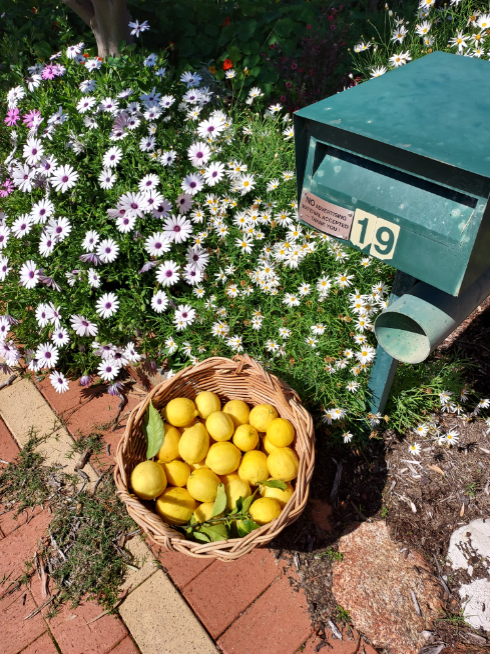
Still sharing lemons with our community 

DH and I have had our second AstroZenica vaccines, and are feeling really good about it. We see this as an important contribution to our community as well as to our own health. 


DH got back into his workshop, after recent surgery, and made this table top easel from scrap wood. The grandchildren loved it! Miss 9 said "Now I am a real artist" while her 3 year old brother said it was what he always wanted! 

The ability to make things we need, rather than to buy them, and to turn waste into useful objects, is a skill we both continue to practice. 

Finally, I try to add my activism to my practivism! This means that I attend rallies, sign petitions, write to politicans, support progressive candidates in elections and attend meetings! You might be interested in this Rebecca Solnit article which explains it further. 

Rebecca Solnit article -it is not all our fault!