Showing posts with label cooking. Show all posts

Saturday, February 15, 2025

It's a journey-; late summer


"it's a journey"
Thanks to Brenna Quinlan who drew this illustration for download from her webpage. I love the way it sees so many of the habits we build as contributing to our slow living, simple living one-planet way of life. 

We find we have our seasons of activity -right now it is a beginning of harvesting and preserving, as the weather gradually cools and the days get a bit shorter. 

I have been able to do some gardening this week. Most of everything is still alive! I am taking cuttings, planting some seeds, tidying up after the heat. 

School is back and that means our Wednedsay babysitting gig is back too. 


I have been trying to finish this quilt for weeks! I have pinned it to the back twice now, and today I will be unpinning it and putting a plain wide back on it. I am hoping for a smooth run from here on! Talk about SLOW! Well, it is right or it is not and I want it to be right.


We managed to get a few bunches of grapes from the grapevine before the birds got them all. Well, the grapevines out the front are for shade mostly. 


DH helped me to do a summer prune of the lime tree, to reduce its height. In the process we have harvested a basket of small tart limes. I have cut some into quarters and flash frozen some for cold drinks -lime 'ice cubes". DH tried a new recipe for lime pickle, but I don't think he is happy with it. The lime peel stayed quite hard, and he found it very salty. I haven't tried it yet -it does say that it should be allowed to stand for a month before we try to eat it. 


DH also got inspired to make mango chutney again. Hooray! 


And a delicious tomato chutney.


I borrowed this book from the library, and we all loved it so much we have bought a copy for our own. 


Marri blossoms in flower are quite spectacular. These ones are at the play centre, where I volunteer in the garden. I have been looking for the golden yellow flowers of the Illyarrie but so far the blooms have been too high in the canopy for me to get a good picture. There is one around the corner from here, and I am keeping my eye on it. 

Thanks for visiting my blog. Hopefully next time I will have a quilt to show you!


Monday, January 27, 2025

It is hot out here-January 2025. The tough get quilting and tidying


Hello again, from a hot Perth Western Australia in the first month of 2025. We are in full summer mode -but even the beach might be too hot for a walk in the morning these days. If it is too hot for the beach, it is probably too hot to work in the garden too. I keep up the watering, and wait for better days. 

We had a week of cyclone-induced humidity and low cloud last week which was weird. When you are used to very hot but very low humidity days with lots of sunshine, and a sea breeze every afternoon, a week without those things is a shock. 


This was my first attempt at foccacia, using the King Arthur Bread company recipe. It was yummy, and I now have a new cast iron pan to cook it in -thanks to Father Christmas, but the oven has been playing up and won't be fixed until later this week so I haven't tried to do it again. 


I heartily recommend this large book about Robodebt by Rick Morton, called Mean Streak. It goes into detail about who knew what and when about the government disaster which claimed debts based on faulty mathematics from unsuspecting welfare recipients. It is a sad story, but there are heroes who kept their moral compass pointed to courage and compassion and truth, no matter how powerful were the voices telling us that it was otherwise. 


I have spent most of January tidying up my sewing room, with the help of the wonderful Karen Brown of Just Get It Done Quilts and her yearly "Declutter Challenge". It is now clear that my bad habit of taking out fabric to test them in a new quilt scheme, then stuffing them back into a drawer, was a really, really bad idea. I couldn't tell what fabrics I had, and they were crumpled and a mess. Quilting is easier in a organised work place. I have promised myself that I won't do that again! 

Fabrics have been sorted -scraps even thrown out.


In the spirit of 'using it up' I finally unpacked a panel which had been in a bag for far too long, and determined that it was either going to be in a quilt soon, or I would throw it out. This is the result. Some scrappy 9 patches, squares of shell fabric and a top is made. I am now, in my now tidy sewing room, working on a pieced back. This thing needs to be a quilt, not just a top, and off to the WAQA Community Quilts group for donation. 


This is the pieced back of the quilt. More scraps in here, but it would have been a lot quicker to use a whole cloth back! 


Do you ever pick things up from the side of the road? I noticed this shelf one day, and immediately drove back home to get the DH. He also thought it was something with potential, so he cleaned it up and painted it and installed it in my sewing room. I love it! It has cleaned up a lot of equipment that I like to be handy but don't want cluttering up my workspaces. 


Tidying up also has arrived at my computer desk, where I have found that this desk tidy which I made out of a shoe box, has transformed the clutter and takes up very little space. The deep box of the shoe box was cut in half on an angle and a small triangle shape removed, then the two ends were inserted into the lid. I saw the idea on pinterest I think. 

I hope I will be back at my blog more often in 2025. It has been a way I document my life, and its simple joys. Wishing you the same joys for 2025. 


Saturday, January 13, 2024

Adventures in Second Hand purchasing

 If we are to live more sustainably on this One Planet Earth we all share, it is pretty clear that we in the industrialised and wealthy countries need to reduce our consumption. One of the ways I try to do this is by choosing to purchase things second hand rather than new, wherever possible.

When we buy second hand, we keep things from landfill, we dampen the demand for manufacturers to make new things all the time, and as a by-product we save money. I try to always look for anything I need first in the free or second hand space, before buying new. 


A picture of our veggie garden and fruit trees

As I try to limit my exposure to all kinds of advertising, I generally have identified an actual need or a sensible 'want' before I go out to look for a product. This month I have been aware of the fact that I have a LOT of last year's citrus harvest in the freezer, and it wasn't moving fast enough into our meals. I need to move it through the freezer to keep the rotation going and have room for other things. Then it occurred to me that I could make sorbet or gelato or icecream and use up the juice that way. That meant finding an icecream maker!*


The ice cream maker I bought second hand

As it happens, ice cream makers are just the kind of appliance to be often available in the second hand market. People buy them with all sorts of aspirations, and then don't make a habit of using them much. At some point it is just an appliance taking up valuable real estate in their kitchen and in their freezer. 

I found a good brand ice cream maker for about one third of the price of a new one. If it should happen that I don't use the machine as much as I think I would, then I have not been much out of pocket. 


Lemon cake with lemon icing on 

a second hand cake stand, plate and glass cover


In order to make room for the icecream maker in the cupboards in the kitchen, we advertised our dehydrator on our local Buy Nothing group. We have realised that in this climate we don't really need a dehydrator. Firstly, most herbs grow all year round, and fresh herbs are usually more flavourful. Secondly, we have a LOT of dry sunny days, and anything we needed to dry could simply be hung somewhere shady and a day or so later it would be crisp. We are happy to let someone else have the dehydrator- we got it for free, so we passed it on for free too. 

So I looked on line in a popular marketplace and found a suitable machine. Sadly, after I got it home I discovered it had a piece missing. The seller didn't have the piece, and offered to reduce the price if I could find a replacement piece from the manufacturer. The manufacturer was not helpful -they said they had a backlog and would take 8-10 working days to get back to me! Hmmm.

I got my money back from the first seller, and checked if I could find a similar machine new in a shop Just as I  was reconciled to this, another machine of exactly the same type as the first one, turned up for sale -and for $10 less! Off I went again and this time all the pieces are there. 

The first Icecream I made is from Stephanie Alexander's book 
The Kitchen Companion" : lime icecream. It was extremely nice, and worth taking to dinner on Friday when our Friday friends group gets back together after a month recess over the Christmas and New Year period. 


I have been reading over the summer period. One of the books I enjoyed from the library was Kate Rawles's story of riding a bike around South America and visiting both biodiversity hot spots and places in trouble, and the people trying to heal the land and change the system.

Everything is connected, they say. One mine, one extinction, is felt everywhere and by everything. Just doing things like taking the trouble to buy second hand or fix something rather than throwing it away, is a tiny act of restoration and rebellion against the forces that will destroy everything we hold dear. 


* Of course, citrus is not just used in icecream. I have been using lemons instead of stuffing in a roast chicken, for a long time. I also use lemon and lime juice in salad dressings, risotto and just flavouring iced water for long summer drinks. The DH makes marmalade from many citrus varieties too. Cakes can be great with citrus.

If you have as many trees as I have, there is a big need to find uses for citrus- even after giving many of the fruit away there is still a lot left. 


Sunday, June 5, 2022

Eat like a peasant


 It is now winter -or more precisely the Noongar season of makuru, which is when we can expect more rain and cooler weather. In the face of the good news of our new government (Yay for democracy! Yay for preferential voting!) we have the continuing bad news of rising prices in just about everything, but especially energy prices. 

As I wrote in my last post, there are some long term things we do to help us cope with inflationary cost pressures. 

I have been reviewing our habits on grocery spending  and genearl food habits this month, and thought I would write down some of the suggestions. One of the things I have been doing is reminding myself of the "peasant lifestyle", through some cook books on my shelf*, as the resourcefulness and simplicity of the peasant lifestyle is a bit of a hedge against feeling powerless in the face of the supermarket price rises. I turn to the classic cuisines of the Mediterranean and Asia for inspiration. 

Here is an article about 'cucina povera" -or peasant food! Click here

Growing some of it ourselves 

It is fair to say that the garden gives me great pleasure, and good exercise. If it did nothing else, it would be a worthwhile investment, but the garden actually provides us with real food which we can eat fresh picked and without any food miles. I deliberately try to grow things which are expensive when bought in the shops, and things which don't travel well -like herbs. Our diet can be tastier, healthier and more varied by doing this. We don't grow potatoes, carrots or onions because they take quite a lot of room in an small garden, if you want to stop buying them from the green grocer altogether. 

The think you notice about the peasant life is that it flows with the seasons. Seasonal food is cheaper, it doesn't need to be transported half the way across the world, and it is fresher. In the Mediterranean diet -often cited as very healthy- fasting is a normal part of the year but especially for the religious seasons of Lent and Advent. Vegetarian food is common, with meat used sparingly. 


What we have been harvesting

Tangelos -these gloriously orangy oranges are fabulous in breakfast juice. Our tree has about 20 fruit this year, and I am saving every single one for us. 

Grapefruit-these are the pink ones, and I reckon there are more than 100 on the tree. I have already given a basketful away to the neighbours through our buy nothing group on social media. We add some of these to our breakfast juice. 

Meyer Lemons -sweeter and juicier than eureka lemons, and we have a very productive tree. Have given away a basketful already this season.

Limes -not just for gin and tonics, but good for these. I will freeze some in quarters, and I am also going to put some in salt -like preserved lemons- for adding to salads and rice and couscous. 

Olives -DH and I are putting away a couple of small jars in brine every few weeks. 


Salad leaves -I am growing  a whole range of 'cut and come again' lettuces, along with rocket and coriander and dill, in the garden at the moment. Most of these are self-seeded, which means that I just let the plant flower, and then the seeds fell into the garden and now I have new plants. Winter is the best time for green leaves in this climate. We also have kale, kan kong, warrigal greens and sweet potato leaves for stir fries. At about $3 per bag of salad leaves at the supermarket, we are doing well in saving money just from this one item alone, especially as ours are always picked absolutely fresh. 

Herbs- soup is better with parsley and thyme, pasta is better with basil and rosemary and oregano. I have bay leaves growing outside. I have makrut lime and curry leaves for curries. Mint for tea and deserts. One read recently that those tiny packs of herbs in the supermarket come out to $200 per kilo! Now, herbs are astonishingly easy to grow- in fact with things like mint and saddle back sorrel the trick is to keep them from taking over the garden. Instead, I keep them in a pot, and feel like one of those TV chefs when I just pop outside and come back with a handful of herbs for my recipe.

How much do we spend on the garden? My budget gives me $50 per month, and I can usually find something to spend it on. I don't buy pesticides or fungicides -but I do buy a bag or two of pelletised manure, and quality potting mix to add to the compost when I am potting up plants. This month I bought rock minerals because Perth sandy soils can be a bit deficient in minerals. I also bought a bag of kitty litter which is made of bentonite clay, because it is a cheap way of getting clay to add to the sand in the garden when I am planting something. Sometimes it  is nice to buy a new plant -I got a bougainvillea this month -but I often can divide or take cuttings when I need to fill a space in the garden. We make compost and get free mulch from the city council, and I am always on the scrounge for free ingredients to add to the garden. This pile of leaves was one such opportunity - I had a bag in the boot so I quickly piled them up and took them home for the compost.


What is the garden worth in dollar terms? I haven't actually done the figures, so I don't really know. We still shop for vegetables and fruit, but I think our diet is more varied, and we have fresher meals because of it. I saw someone offering home grown grapefruit for $1.50 each! I have more than 50 on the tree -so that is a significant cost saving right there. 

If you have the land -or even a bit of a sunny balcony or a strip of land next to a driveway, I think you can eat from the garden and save money. 


*Books like "Honey from a weed" by Patience Grey , and  Rick Stein "From Venice to Istanbul" 

Other Resources

Integrated pest management

It's OK really 

Great tips here  from Zero Waste Chef

Friday, April 1, 2022

Waiting for rain, and other Djeran activities


Djeran season at last sees a break in the really hot weather. A key indicator of the change of season is the cool nights that once again bring a dewy presence for us to discover in the early mornings.

The winds have also changed, especially in their intensity, with light breezes being the go and generally swinging from southerly directions (i.e. south east to south west). Many flying ants can be seen cruising around in the light winds.

Djeran is a time of red flowers especially from the Red Flowering Gum (Corimbia ficifolia), as well as the smaller and more petite flowers of the Summer Flame (Beaufortia aestiva). As you travel around the Perth area, you may also notice the red 'rust' and seed cones forming on the male and female Sheoaks (Allocasuarina fraseriana). Banksias start to display their flowers, ensuring that there are nectar food sources for the many small mammals and birds that rely upon them. Source: http://www.bom.gov.au/iwk/nyoongar/djeran.shtml


Eagerly we are watching the skies, the weather charts, the plants in the garden. There have been a couple of very short showers of rain, and the temperatures are gradually cooling down to the low 30C. Is the summer over? Can we start planting autumn crops? Can the garden recover from the heat? 

A week or so ago I took down one shade sail, on the western side of the house. We have a large bottlebrush tree there, and the bed is planted with cumquat, sweet potato, fennel, basil.When the garden did not die from the heat (!) I took the rest of the shade sails down too. I rather too hopefully planted some rainbow chard and 12 garlic cloves, but it may be a bit early yet. 

The garden has survived the summer, but it was not as productive as I hoped, and I don't really know why. I planted some zucchini but had only one fruit, even though there were plenty of flowers. The passionfruit has had lots of flowers, but no fruit set either. The pumpkin that self seeded has only one fruit on it. The dwarf beans I planted came to nothing. I wonder about the pollinators -was it too hot for the bees? There are some  bee attracting flowers in my garden all the time -I have alyssum, which bees love, and nasturtiums, and parsley, and basil, but it has been some time since I saw the bees out in force.

Gardening, no matter how long you have been doing it, is an exercise in observation and patience. If I was actually relying on the garden to feed us, there would be times when we had a 'hungry gap'. Nevertheless, we are now harvesting limes, pomegranates, fennel and mint. DH found an olive tree on the street near our home, with small black olives, and harvested 3 jars for a quick batch. Our kalamata olives are very green still. 

If the rains come, I hope the parsley will come back again - I miss it! 


I continue to play with my sourdough recipe. Lately I have been adding 3 teaspoons of malt powder - I used to use malt extract, the syrupy stuff but I have found malt powder used by amateur beer makers, and it is great. It adds crumb and makes a great crust, as well as adding some nutrients to the bread. I am also using flax seed too. 


My favourite tree is now in flower around the suburbs : Eucalyptus erythrocorys, commonly known as illyarrie, red-capped gum or helmet nut gum, from Western Australia. It has smooth bark, sickle-shaped to curved adult leaves, characteristically large flower buds in groups of three with a bright red operculum, bright yellow to yellowish green flowers and sculptured, bell-shaped fruit.


It was our great delight to finally -after 2 whole years -see and hear the Australian String Quartet live in concert. They had been unable to attend in person, due to WA's COVID restrictions on travel. We are now open to the world (!) and COVID is at last running through our community. I know this is very different to the experiences of others in Australian states, and in other parts of the world, but our State Government took the stance to protect us until we had the chance of getting most of the population safely vaccinated, before opening up. It was hard for some families, being so isolated from relatives, but so far our hospitalisation and death rates are far below other places. We have to wear masks indoors, and that is a struggle for some people, but it is helping to keep vulnerable people safe. I hope that wherever you are, you are taking care and finding ways to connect with others even though the pandemic is not over, not by any means

Finally, I have a couple of recommendations for you: 

Recommended Book 

Henry Reynolds "The Other Side of the Frontier"


Recommended Podcast 

We talk a lot about agricultural practices, climate change, and the global food supply, and the news is not always great. Rebecca Ruda reflects on the anxiety this can cause and reminds us that just as the problems of the world deserve our attention, so does our mental health. She provides tips for recognizing anxiety symptoms and openly shares her own experience. Then Rebecca offers simple but useful strategies for continuing the work of advocating for nature without doing harm to ourselves.


Perth heat

Wednesday, February 24, 2021

Late summer


It is late summer in Perth, and the sea breezes come most afternoons- except when they don't and it gets really hot (39C) and doesn't cool down much overnight. We have been lucky and had some milder weather in between the hot spells. I have most of the garden thriving, or at least surviving! 

My own seedling fig is not producing fruit but it is young,  but I have a quilting friend with a prolific tree, who was glad to bring some along to share! There is something so luxurious about a ripe fig -sweet and sticky but a slightly bit acid too.

Due to the warmth, my sourdough batter  rises quickly. I try not to start it too early the evening before, and can just leave it on the bench. I find myself getting up early to bake before it gets too hot here, and to catch the dough before it gets exhausted. 

I am drying calendula flowers for tea, and thinking about making some herb salt with dried rosemary, thyme, lemon verbena and celery leaves. 


I took this picture of our dresser in that glorious afternoon light that comes just before sun goes down. Once or twice the local State governments have wondered if we should have summer time daylight saving in Perth, but when we tried it, many people found it too hot into the evening, and we were worried about the children walking home from school in the absolute hottest part of the day. So we have sunset to look forward to, with the drop is temperature which mostly arrives with it.


Even though I have two different lemon trees - a Eureka and a Meyer, I have almost no ripe lemons a all at the moment, but I have all the limes I need, though they are a bit hard and therefore not actually ripe yet. I tend to leave them on the tree if I can keep the Mediterranean fruit fly away from them, as DH makes the most remarkably good Golden Lime marmalade. One of our Australian cooks of note, Maggie Beer, says she loves the limes when they are golden. I do too! 


We are waiting anxiously for our first pomegranate to ripen this year. Once I used them to make pomegranate molasses -a big, fiddly job properly left to the experts. Pomegranates are a symbol of Easter and resurrection, and also just the taste of summer! 


After a few days of cooler weather, I returned the shade cloth to the veggie beds. This one has a shade structure I have just made from a salvaged metal hoop from a child's swing set, along with some star pickets and some plastic trellis I have used many times before. I am wondering if I can get another quick crop of snake beans in before the end of March when the weather usually turns cooler?


As a subscriber to Choice Australia, I get the benefit of their product reviews. The cast iron casserole dish is a cheap discount supermarket copy of the well known one that costs hundreds of dollars. I have often wondered about buying the expensive one, but was concerned that maybe it would be too heavy for me to lift, and I didn't want to spend that kind of money with such a risk. Choice said this particular copy held up very well in their tests, and was 90% cheaper! I thought it was worth a try, and I love it. Being able to brown things on the induction stove top and then bung it in the oven is convenient. It is a good size for roasting the free range chickens my local independent grocer marks down Sundays when they are nearing their 'best before' date. 


This picture if part of our first market stall with DH's cheese boards and knives and trivets, and my bags, teacosies. We learned a lot on our first try out, will be working on another one later. This time I want to go equipped with lots of bunting and a sign for our marquee, and take the time to do a bit of extra presentation. My DIL has some lovely pot covers for sale, and I reckon I might be able to pot up some plants to go with them. 


Monday, August 17, 2020

New Stuff to DIY


We have been experimenting with some new things to make ourselves, here at home.

Soft Cheese
DH is the yoghurt maker in this house, and he makes great yoghurt. Recently he found out a friend was using similar skills and equipment to our yoghurt making, to make their own soft cheeses like cottage cheese, ricotta and even brie. 

It turned out we had some equipment that DD had brought home from an op shop, so this week he made our first batch of ricotta. It is very satisfactory and easy. That left us with 2 litres of whey, which I then used to make this loaf of sourdough bread -and it rose very well.


Diastatic Malt
I have learned that there is another additive for bread  which can be made at home from barley! After the first green shoots appear, I will dry this barley and grind it up to make diastatic malt, which I am told supports a strong rise, great texture and brown crust. As I already had a seed sprouter, a dehydrator and have a good grinder, this will be easy enough I think. I wonder if it will make a big difference? I have some 'bread improver" which does not seem as natural in its ingredients as diastatic malt, so I would be interested if I can make an additive for bread here at home which is more natural 


Instructions for making diastatic malt for bread! https://www.sourdoughbreadrecipe.com.au/slider/malt-flour-for-sourdough-diastatic-or-non-diastatic/

Grow new fruits

We have bought ourselves two trees, both of which are grafted with two varieties of fruit. One has Granny Smith and Golden Delicious apples, and the other has Flavour Supreme and Maraposa plums. We planted them in two big garbage bins, as they were the largest and cheapest pots we could find. Eventually they will go in the ground here, but we wanted to test them in this spot, to see if it was too hot for them, before commiting to the digging up of the paving, etc.


There have been sunny days and a lot of wet days lately. The garden is showing signs of spring -the bottlebrush is coming into flower already. I have shoots on the roses, the borage is flowering, and the birds are nesting.


When I am not dodging the showers to turn compost or pull weeds, I am either cooking or reading. My latest favourite book is Rosemary Morrow's Earth Users Guide to Permaculture. I have the Kindle version. It is a fantastic resource, and I am now re-reading it and working my way though it's suggested activities. 


I leave you with this quote

Howard Zinn said, “To be hopeful in bad times is not just foolishly romantic. It is based on the fact that human history is a history not only of cruelty, but also of compassion, sacrifice, courage, kindness. What we choose to emphasize in this complex history will determine our lives. If we see only the worst, it destroys our capacity to do something. If we remember those times and places - and there are so many - where people have behaved magnificently, this gives us the energy to act, and at least the possibility of sending this spinning top of a world in a different direction. And if we do act, in however small a way, we don’t have to wait for some grand utopian future. The future is an infinite succession of presents, and to live now as we think human beings should live, in defiance of all that is bad around us, is itself a marvelous victory."

Saturday, July 11, 2020

You are needed

Three pictures: preserved lemons, pumpkin in a dish and stock

More than a decade ago, I was a full time working mum with two adult children at home and a full time working husband. We were doing the whole thing! Commuting, travelling for work, worrying, working late or at home, trying to get by.  The thing is, I was not happy. My weekends were not enough to reset my equilibrium before the week started again and I was back in the grind.

I started searching for anything which would improve the way we lived. It led me to the Simple Living movement -to bloggers and forums and books. It made sense! We started, very slowly, to change.

One of the best things we did was to put a sign on the letterbox to say 'no junk mail' and immediately we stopped seeing those colourful glossy catalogues which are full of attempts to make us buy things we don't need. We stopped using shopping as recreation. We watched less commercial television so we saw fewer advertisements. We started to learn about growing things, making a lot of mistakes but having enough success to keep going. We started to find new ways to do things for ourselves, and our sense of confidence and happiness grew along with our skills. 

This week has been part of the long and abundant harvest of those changes. It has seen us be happy to be at home, to try to help others where we can, to do things for ourselves. I cut up another pumpkin we grew, and roasted some for a recipe. The peels went into the stock pot with other veggies which were getting tired in the fridge, plus herbs and onions from the garden. I brought the stock to the boil and put it in the hot box for several hours. I put some lemons in a jar with salt and spices to make preserved lemons. I made bread, as usual. We had a lovely chaotic day with the grandchildren and in the midst of it all we made bread together and jam drop biscuits. They picked things from the garden, and sampled edible leaves -some they hated, others were a big hit. DD has been back volunteering at the op shop she works in, DH has been doing the important work he does for another community group and I have been involved in a couple of community based groups too. 

Four purple flowering plants

The rain left us for a few days and we used the time to put some tree prunings through my new shredder and add the result to the compost. My compost is going so much better in recent months as a result. It gets hotter and produces a better, finer compost. We have continued to add flowers to the garden, to support the insects and birds who come here. I was delighted to see a wattle bird in my veggie patch, eating bugs on the rainbow chard. I have planted another Happy Wanderer -the deep purple one-to add to the pink one which grows up a post which holds up our summer shade cloth. 

Geoff Lawton said on a post this week "Flowers are a functional part of pest management in a permaculture garden where pests are confused by colour, scent, patterned form, and predators favoured with perches, ponds and rockeries".


Pinning a quilt on an outside table

I worked in the garden, pinning together a quilt with a garden theme! Now to start quilting it -first with a walking foot and then with some free motion quilting. Nothing makes me quite so happy as doing this in the garden on a sunny winter's day. 

I read a lovely quote this week which I wanted to share with you all.

Remember the earth. Remember your ancestors. Remember your four-legged, winged, crawling relatives. Remember life. Your life, your way of living, that is the only activism you’ve ever had. Use it. Make your existence a ritual that honors everything your body and words touch. The times are troubled and you are needed. Wake up—notice the consequence of every action and non-action. You are needed. You are needed. You are needed.” - Eric Chisler

I hope we can all live in ways that bring our world to the healing we all need. 

Here are some links you might enjoy and be inspired by

Morag Gamble has a new podcast! "SENSE MAKING IN A CHANGING WORLD podcast where I explore the kind of thinking and permaculture action we need to navigate a positive way forward" Find it at your usual podcast app or listen here

Do you read Pip magazine? Lots of wonderful resources here 

Sunday, May 31, 2020

Makuru: Winter in South West (Australia)


It has been wet and cold (in relative terms!) for us this week. The garden is refreshed and the water tank a third full again. Hopefully we can get more rain to fill it up again before winter is over. 


We have been experimenting with the use of the new "Hay Box"  (above) that DH made for me.  
Since my last post, DH painted the Hay box and it has found a permanent place in my laundry. 

 It is great for proofing my sourdough overnight. Last winter I used to wrap the bowl in a blanket on the kitchen bench, or heat the oven very slightly and put the bread in there. With the Hay Box I just put the bread dough in an oiled saucepan and tuck it in to the Hay Box. The method of making sourdough to this stage does not, of course, have any heat, so as I have a microwaveable stone pad, I heat it slightly in the microwave for 1 minute on medium, then put that underneath the dough in the saucepan. The last step is to tuck a cushion I made from a leftover curtain, stuffed with more leftover Earthwool insulation on top before I add the lid. The couple of times I have used the Hay Box the bread has risen beautifully by morning. 


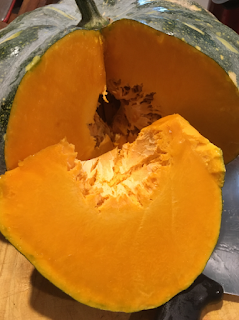
The first of our pumpkins was harvested. I weighed it as 6 kilos! If you have bought pumpkin from a supermarket (or bought it in a can, as apparently happens in some places) you have really never experienced the wonder that fresh pumpkin can offer, cut on your kitchen bench with the fragrant perfume of ripe orange flesh which is dripping with juicy goodness. It is of course pumpkin season, so pumpkin is only $3 a kilo at the moment, but still, that one is worth $18 and all I did was let it run rampant under the citrus in the back yard. There are 5 more out there! 

With 6 kilos to manage, I had to get busy in processing it. I roasted some and it went into the pumpkin soup, which I started on the stove and heated to boiling and put it in the Hay Box for about 7 hours. When we got it out for dinner the internal contents were +60C which is fine. I blended the soup and heated it a bit on the stove before serving, adding a squeeze of lemon to take the edge off the sweetness. 

Some of the pumpkin was just steamed in the microwave and frozen for later use. 


My granddaughter (aged 8) came over and we made pumpkin scones, and then the rest of the family came to help us eat them. 

Another use of the Hay Box was that I cooked some jasmine rice in an equal volume of boiling water for 5 minutes and then tucked the pot into the slow cooker for about 90 minutes. When I pulled it out the rice was beautifully cooked by the absorption method with no dried overcooked rice on the bottom. I can see me thinking twice about the electric rice cooker -maybe it could go, and this would become the favourite method around here from now on. 

If you are interested in Hay Box cooking, you might find this link helpful - about Hay Boxes and temperatures here 

This weekend is a Long Weekend in our state, for the "WA Day" holiday. It is also National Reconciliation Week. "We strive towards a more just, equitable nation by championing unity and mutual respect as we come together and connect with one another. On this journey, Australians are all In This Together; every one of us has a role to play when it comes to reconciliation, and in playing our part we collectively build relationships and communities that value Aboriginal and Torres Strait Islander peoples, histories and cultures".

I have been reading Layla Saad's book "Me and White Supremacy". It is a difficult and thoughtful work. We have much to do here in Western Australia to overcome our terrible history of oppression and marginalization and dispossession of the Indigenous people of this land.  Watching the USA in terrible conflict over race relations is scary and sobering. 

I was much saddened by the terrible news about the destruction of a 43,000 year old site of Aboriginal culture THIS WEEK by RioTinto, who blew it up to extend a mine, and did so 'legally'. Sure, they got around to apologising, but there is no way to compensate the traditional owners, let alone all of us, for the loss of this site of world significance. 

I leave you with this thought.