It is a big quilt so I got a longarmer to do a lovely swirly pattern -sort of like the wind which swirls at the top of Kunanyi.
Tuesday, August 16, 2022
My Kunanyi quilt is done
It is a big quilt so I got a longarmer to do a lovely swirly pattern -sort of like the wind which swirls at the top of Kunanyi.
Saturday, August 6, 2022
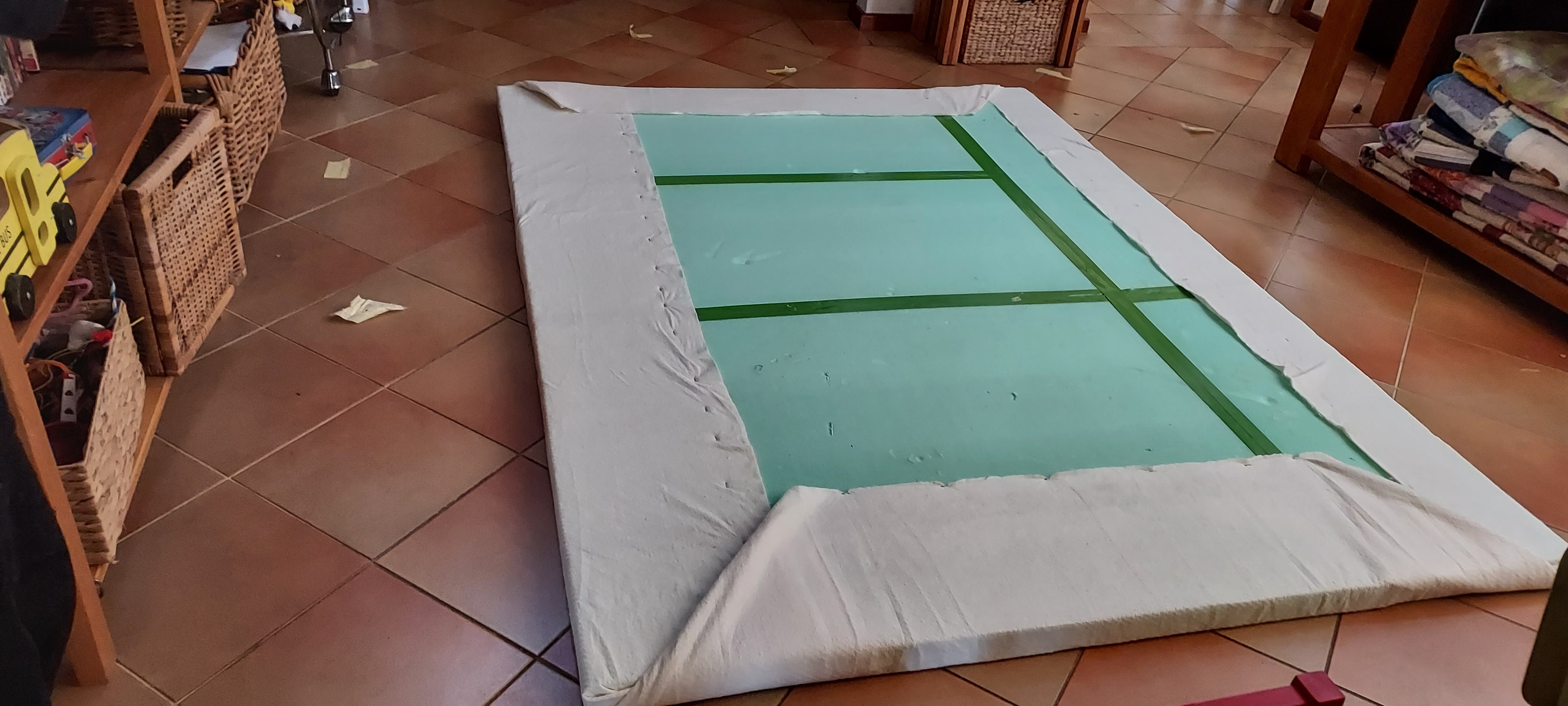
New Design Wall- with how to do it yourself
Here it is in all its glory! Solid, smooth, not wobbly or flimsy.
Thank you Mr DH! 💗💗
Sunday, July 17, 2022
Winter -lots of sun, and then lots of rain?
Our Garden
It has been an off again and on again sort of winter so far. We had a couple of good downfalls, -enough to fill the water tanks- then about a week or more of sunny dry weather. The garden thinks it is spring -and so I am finding tomato seedlings everywhere, and it is hard to prune roses when they are growing madly.
As a result of climate weirding, our rain bands are sliding away down south of us, so that the northern suburbs of Perth are often in sunshine when the south is getting a drenching. This is the way it has been going for decades now. Given that we are in a mediterranean style climate, where we get a long summer drought and a short wet winter, the effect is that we are now relying on desalination plants for our water to such an extent that the state government is going to build a third desal plant, and our water costs are now getting much more expensive.
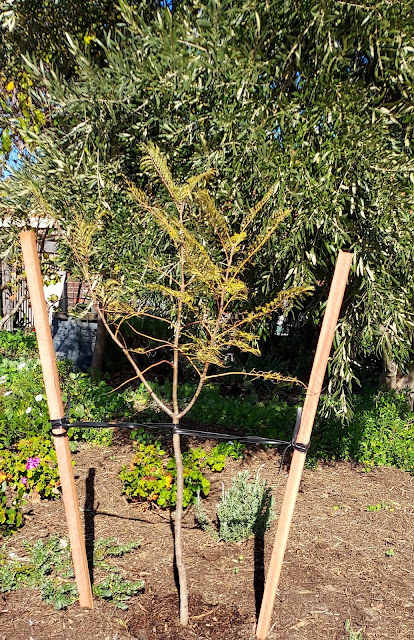
We live in the northern suburbs, and so I am glad that we have already planted a number of trees which can provide some shade for the garden. Our city council has a program of planting street trees. I have been lucky enough to get them to deliver and plant a Jacaranda tree. It is going to have lovely blue flowers, and as it is deciduous will let winter sun into the garden.
As a result of the winter sun, I have been able to do a lot of gardening. I have planted a dwarf mulberry in a pot -which I will need to keep under control rather like a large bonsai, but which I hope to get some big fruits. I have a mulberry tree in the garden, but the fruit is small. As my dietician and I have worked out that I am super sensitive to sorbitol, found in many stone fruit, I am looking to berries more. Fortunately citrus is OK in my diet because we have lots of citrus. The pink grapefruit have been abundant this year -I keep pressing them on people when they come to my house, and the basket at the letterbox has been filled several times.
I bought another crown of rhubarb -this is another 'fruit' on my safe list.
I planted a wicking bed of mint varieties -grapefruit mint, lime mint, chocolate mint and variagated pineapple mint.
I am very happy with the way the verge garden is growing. This was brick paved 18 months ago. DH and I got a load of free mulch from the council recently, so it is looking fine at the moment. The mulch cools the soil, keeps it moist, and rots down to feed the microbes in the ground. There is a 'river" of everlastings which I planted, which should look pretty good once spring arrives.
Recommendations
I ordered some actual hard copy books, during the Black Inc end of financial year sale. I usually just read ebooks or get library copies, but these were cheap and quite good reads. Lisa Wells book "Believers" making a life at the end of the world" was particularly good.
We have also been re-reading Pope Francis's encyclical "Laudato Si" which is very good.
You might also like this article:
War with the trees by Rebecca Solnit
Or you would watch on YouTube- Shade as a dryland strategy -with Geoff Lawton
And here is someting interesting -Free pdf -Biophilic design
Quilting
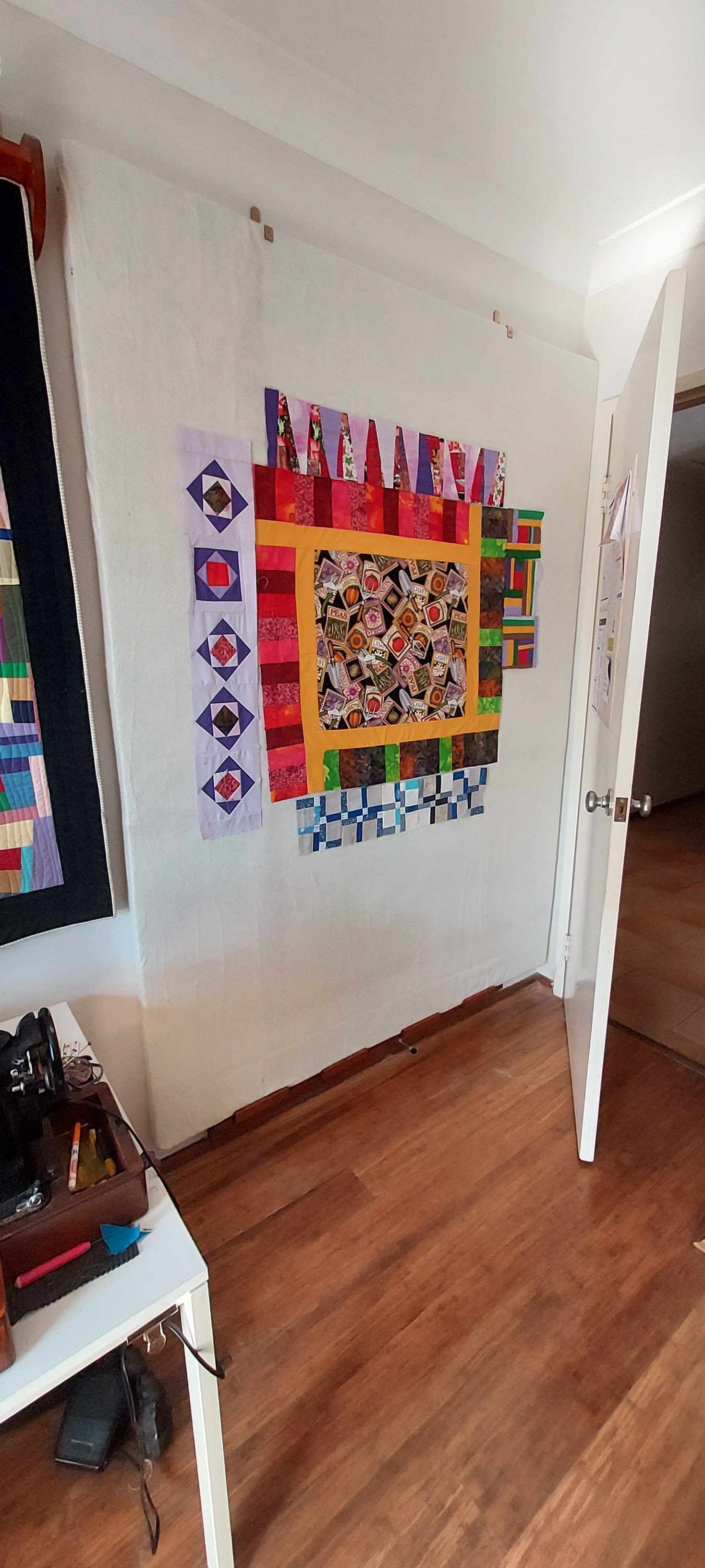
I delivered my Kunyani quilt (above) to the long armers, and have started on a fun improv quilt below. This is still very much a work in progress. It could be very different when it is finished. It is too dark at the top and bottom in this photo, so I am creating something different.
Covid
We have been celebrating our grandson's 8th birthday despite the fact that his party had to be delayed due to Covid hitting the parents -again. We went to a favourite park on what should have been his birthday party day, and had a good time.
Covid is rampant through our community and yet people are still not taking obvious precautionary measures. As it is winter, and there is also a flu epidemic, I find this recklessness to be concerning. DH and I are trying to stay safe without becoming hermits! We wear masks indoors, we limit our exposure to risky settings like shopping centres and restaurants and bars. Nevertheless we have had some friends at our place for lunch and for dinner -with appropriate ventilation.
Podcast fun- and a tidy up too
I have enjoyed listening to A Slob Comes Clean- a podcast about getting control of the house -by someone who is (probably) neurodiverse. The author identifies as a creative person who is easily distracted and who finds it hard to do anything consistently. She says her brain is different than other people's and that is why household tasks are always a struggle for her.
I guess most people coming to our home would not have seen it when it was a disaster area - DH and I clearly remember having a couple of police officers come to see about a burglary some years ago, and telling them "no, the place hasn't been ransacked-it always looks like this". It was about this time that I started searching for any ideas about how to get on top of things. I found "Sidetracked Home Executives" at the library and that was the beginning of a system which made all the difference.
Later on I did "Flylady" routines for about a year or so.
One thing I know, the less stuff I have at home, the easier it is to keep it under control. This is hard for all of us who live here -we are natural collectors! I found the podcast mentioned above a bit of a boost or refresher to keep on ridding the place of stuff we don't use and don't need. It is an on-going task. Right now I am working on throwing out socks that have holes. Yes, I know that I could darn them -I even know how- but unless they are my really good wool ones, that is not going to happen. The sock drawer works best when everything in it is actually wearable, and it feels a bit like a luxury to know you can pull anything out of the drawer and find it useful.
Volunteering
Later this week I will be working on the playcentre garden again. They got a grant for some garden improvements, and so I am going to refresh some very tired hanging baskets with new liners and will plant strawberries. We also have a small ficus, a hoya and some mint to plant in the entrance area which is now very bare.
I hope you are having a good safe time whereever you are -and if it is winter where you are, that you are finding good things to do to keep active. Stay safe and thanks for reading this far.
Sunday, June 5, 2022
Eat like a peasant
It is now winter -or more precisely the Noongar season of makuru, which is when we can expect more rain and cooler weather. In the face of the good news of our new government (Yay for democracy! Yay for preferential voting!) we have the continuing bad news of rising prices in just about everything, but especially energy prices.
As I wrote in my last post, there are some long term things we do to help us cope with inflationary cost pressures.
I have been reviewing our habits on grocery spending and genearl food habits this month, and thought I would write down some of the suggestions. One of the things I have been doing is reminding myself of the "peasant lifestyle", through some cook books on my shelf*, as the resourcefulness and simplicity of the peasant lifestyle is a bit of a hedge against feeling powerless in the face of the supermarket price rises. I turn to the classic cuisines of the Mediterranean and Asia for inspiration.
Here is an article about 'cucina povera" -or peasant food! Click here
Growing some of it ourselves
It is fair to say that the garden gives me great pleasure, and good exercise. If it did nothing else, it would be a worthwhile investment, but the garden actually provides us with real food which we can eat fresh picked and without any food miles. I deliberately try to grow things which are expensive when bought in the shops, and things which don't travel well -like herbs. Our diet can be tastier, healthier and more varied by doing this. We don't grow potatoes, carrots or onions because they take quite a lot of room in an small garden, if you want to stop buying them from the green grocer altogether.
The think you notice about the peasant life is that it flows with the seasons. Seasonal food is cheaper, it doesn't need to be transported half the way across the world, and it is fresher. In the Mediterranean diet -often cited as very healthy- fasting is a normal part of the year but especially for the religious seasons of Lent and Advent. Vegetarian food is common, with meat used sparingly.
What we have been harvesting
Tangelos -these gloriously orangy oranges are fabulous in breakfast juice. Our tree has about 20 fruit this year, and I am saving every single one for us.
Grapefruit-these are the pink ones, and I reckon there are more than 100 on the tree. I have already given a basketful away to the neighbours through our buy nothing group on social media. We add some of these to our breakfast juice.
Meyer Lemons -sweeter and juicier than eureka lemons, and we have a very productive tree. Have given away a basketful already this season.
Limes -not just for gin and tonics, but good for these. I will freeze some in quarters, and I am also going to put some in salt -like preserved lemons- for adding to salads and rice and couscous.
Olives -DH and I are putting away a couple of small jars in brine every few weeks.
Salad leaves -I am growing a whole range of 'cut and come again' lettuces, along with rocket and coriander and dill, in the garden at the moment. Most of these are self-seeded, which means that I just let the plant flower, and then the seeds fell into the garden and now I have new plants. Winter is the best time for green leaves in this climate. We also have kale, kan kong, warrigal greens and sweet potato leaves for stir fries. At about $3 per bag of salad leaves at the supermarket, we are doing well in saving money just from this one item alone, especially as ours are always picked absolutely fresh.
Herbs- soup is better with parsley and thyme, pasta is better with basil and rosemary and oregano. I have bay leaves growing outside. I have makrut lime and curry leaves for curries. Mint for tea and deserts. One read recently that those tiny packs of herbs in the supermarket come out to $200 per kilo! Now, herbs are astonishingly easy to grow- in fact with things like mint and saddle back sorrel the trick is to keep them from taking over the garden. Instead, I keep them in a pot, and feel like one of those TV chefs when I just pop outside and come back with a handful of herbs for my recipe.
How much do we spend on the garden? My budget gives me $50 per month, and I can usually find something to spend it on. I don't buy pesticides or fungicides -but I do buy a bag or two of pelletised manure, and quality potting mix to add to the compost when I am potting up plants. This month I bought rock minerals because Perth sandy soils can be a bit deficient in minerals. I also bought a bag of kitty litter which is made of bentonite clay, because it is a cheap way of getting clay to add to the sand in the garden when I am planting something. Sometimes it is nice to buy a new plant -I got a bougainvillea this month -but I often can divide or take cuttings when I need to fill a space in the garden. We make compost and get free mulch from the city council, and I am always on the scrounge for free ingredients to add to the garden. This pile of leaves was one such opportunity - I had a bag in the boot so I quickly piled them up and took them home for the compost.
What is the garden worth in dollar terms? I haven't actually done the figures, so I don't really know. We still shop for vegetables and fruit, but I think our diet is more varied, and we have fresher meals because of it. I saw someone offering home grown grapefruit for $1.50 each! I have more than 50 on the tree -so that is a significant cost saving right there.
If you have the land -or even a bit of a sunny balcony or a strip of land next to a driveway, I think you can eat from the garden and save money.
*Books like "Honey from a weed" by Patience Grey , and Rick Stein "From Venice to Istanbul"
Other Resources
Great tips here from Zero Waste Chef
Friday, May 6, 2022
Inflation -some strategies for avoiding spending money
NOTE: I know many others have it much tougher than we do, and I am sorry, really sorry. If this blog post is not helpful because you just don't have enough money now let alone when prices go up, please know that I have been there too, and I really hope our society can be kinder and fairer to everyone. In Australia that means, at the very least, we should raise the rate of Newstart to something like $80 per day.
Get it for free
This is a devil's ivy plant, which was given away on our local "Buy Nothing" site, because it really really needed some plant first aid. Now, I have quite a collection of indoor plants, and enjoy growing them up. They can cost quite a few dollars, but last a long time if cared for and in the right place.
Lend it
If you can't get it for free -maybe you know someone who would lend you something you only need for a little while. I read somewhere that most electric drills are used for only 4 hours. People want it to do one thing, buy it and never use it again. In some parts of Australia folk have set up lending libraries of things like camping equipment, garden and workshop tools and the kind of things you need for a big party, but don't need very often. If you take good care of the item you borrow, and return it on time, you will keep your friend happy.Maintenance Pays Off
We have all had that experience of suddenly discovering that the washing machine won't work, or the dishwasher is making odd noises, or the car has a warning light on the dashboard. Not only is it often extremely inconvenient, it is also really expensive. Getting a tradie to visit your home involves a 'call out fee' even before they have started work.
I try to do routine maintenance on my appliances to ensure that they last as long as possible, and that such emergency service calls are only required infrequently. I am not in any way a technical or mechanically minded person, but I can easily clean the filter on the dishwasher, and often give it an extra clean with lemon juice or vinegar, to clean off scale and mould in the pipes and hoses. One of my friend's adult daughters watched some YouTube videos before succesfully fixing their washing machine.
My car does get it's regular service, and now that we use a mobile mechanic who comes to our home, we notice that they do not try as much as the franchise mechanic, to on-sell us extra parts like air filters.
Cleaning out the gutters before the winter rains is a good maintenance tip. Water in the roof can be really expensive to fix.
If you can sew, a bit of repair on a hem or a button can save money on buying another item of clothing.
If you have your appliance handbook, there may be some tips about regular maintenance and what to do if it stops working. I have mine in plastic pockets in a lever arch folder, and this has saved the day many times. Like the time we somehow put the child lock on the induction cook top -and nothing worked. before panic set in completely, we remembered the manual, which told us how to fix it, without a call out fee!
Plan for replacement -or do without
We are using YNAB for our budgetting, and I love it. One of its rules is that a good budget knows the difference between an emergency and a 'true expense'. True expenses are things like buying new tires for the car -usually not an emergency, we should be able to predict that we will have to do this at least months if not years in advance. Similarly, we should be able to predict that a 7 year old appliance is probably going to need replacing sometime in the next year or so. If we set aside small amounts regulary to cover such replacements, we should not have our budget wiped out by them. In fact, if it works well, we just pay it! No drama at all!
Of course, if there are too many things which need replacing all at once, before the budget has enought in it, we might be in difficulty. At such times we might just have to get by without the appliance for a time. In an inflationary environment, it will possibly be much more expensive to replace our appliances than when we bought them some time ago, and so knowing how to do without for a time, is a really good strategy. I know that I can wash all the dishes by hand, even though I would rather not, but I would struggle to wash clothes by hand so I would priorities a washing machine over a dishwasher if it had to be one or the other.
Of course, you can budget this way without YNAB -we did for years with a spreadsheet, but the idea of true expenses is important to know.
Do It Yourself
Some years ago I was part of a website and forum which taught frugality. One of the people there was a woman who had suffered an injury at work and so was unable to contribute cash to her family by paid work. She worked hard on finding ways to replace the things they had bought with cash, with things she could make using the time she had once traded for dollars at work. If she had been used to purchasing a packet of biscuits, for example, she made biscuits. If they were used to buying soap powder, she made her own. She actually went to the shop, studied the list of ingredients, went home and researched and experimented to find replacements. If you have the time to give, you can replace many consumer and manufactured products with your own ready made items, at cheaper cost, without fancy packaging, shelf stabilisers and funny ingredients.
You can make your own curry powder, grow your own herbs, bake your own bread, culture your own yoghurt and make clothes. I learned a lot from this woman's example, and now have many items we regularly make ourselves.
In the garden I make compost, which uses up things we would otherwise throw away, and get a soil amendment to help me grow fruit and vegetables which saves me money too. Our worm farm makes the best soil amendments. Sometimes I simply take the 'do nothing' approach -if the plant is a bit sick, and I have watered it and fed it, and it still has problems I wait to see if the ecological niche it lives in will support it or whether it was just wrong for this place. I don't buy poisons and amendments for the garden.
DH is a handy person who has helped us a lot by putting up shelves, painting walls, making and repairing furniture, repairing loose screws and such. Often a simple tool kit, picked up cheaply in garage sales, can make a big difference-every house should have a screw driver or three, a hammer and a pair of pliers. Dh often recycles things we get for free from our local Buy Nothing group, or cheaply from the Tip Shop. These lovely windows came from a neighbour for nothing.
Just today he replaced a towel rail in the main bathroom, which had actually broken off at the part where the rail joins the supporting plate attached to the wall. Imagine if we had to get a tradie in to do that job -it would have taken a lot more than the $70 for the new rail.
Don't forget to Pay it Forward
Finally my advice is to try to be content with things -and here is a small article which may assist
Home renovation of a modest budget
Sunday, April 24, 2022
When you do stuff, stuff gets done
Perth is drying up
Friday, April 1, 2022
Waiting for rain, and other Djeran activities
Djeran season at last sees a break in the really hot weather. A key indicator of the change of season is the cool nights that once again bring a dewy presence for us to discover in the early mornings.
The winds have also changed, especially in their intensity, with light breezes being the go and generally swinging from southerly directions (i.e. south east to south west). Many flying ants can be seen cruising around in the light winds.
Djeran is a time of red flowers especially from the Red Flowering Gum (Corimbia ficifolia), as well as the smaller and more petite flowers of the Summer Flame (Beaufortia aestiva). As you travel around the Perth area, you may also notice the red 'rust' and seed cones forming on the male and female Sheoaks (Allocasuarina fraseriana). Banksias start to display their flowers, ensuring that there are nectar food sources for the many small mammals and birds that rely upon them. Source: http://www.bom.gov.au/iwk/nyoongar/djeran.shtml
Eagerly we are watching the skies, the weather charts, the plants in the garden. There have been a couple of very short showers of rain, and the temperatures are gradually cooling down to the low 30C. Is the summer over? Can we start planting autumn crops? Can the garden recover from the heat?
A week or so ago I took down one shade sail, on the western side of the house. We have a large bottlebrush tree there, and the bed is planted with cumquat, sweet potato, fennel, basil.When the garden did not die from the heat (!) I took the rest of the shade sails down too. I rather too hopefully planted some rainbow chard and 12 garlic cloves, but it may be a bit early yet.
The garden has survived the summer, but it was not as productive as I hoped, and I don't really know why. I planted some zucchini but had only one fruit, even though there were plenty of flowers. The passionfruit has had lots of flowers, but no fruit set either. The pumpkin that self seeded has only one fruit on it. The dwarf beans I planted came to nothing. I wonder about the pollinators -was it too hot for the bees? There are some bee attracting flowers in my garden all the time -I have alyssum, which bees love, and nasturtiums, and parsley, and basil, but it has been some time since I saw the bees out in force.
Gardening, no matter how long you have been doing it, is an exercise in observation and patience. If I was actually relying on the garden to feed us, there would be times when we had a 'hungry gap'. Nevertheless, we are now harvesting limes, pomegranates, fennel and mint. DH found an olive tree on the street near our home, with small black olives, and harvested 3 jars for a quick batch. Our kalamata olives are very green still.
If the rains come, I hope the parsley will come back again - I miss it!
Recommended Book


.jpg)


.jpg)


.jpg)
.jpg)
.jpg)