I was speaking with friends this week, about our Greenwood Fresh Food pantry and the challenge of feeding a family on a very limited income which one of them was doing for Lent, and it got me thinking about the strategies I use for shopping for food which may not be known by everyone, but which I have found out through the very generous people who are part of the Simple Living community. It is turning into quite a long post! Maybe you need to get a beverage of choice and read along.
Inspired by people like Rhonda Hertzel and her book The Simple Home, most of us who have taken on the Simple Living approach know that we can feed ourselves well -and more cheaply -if we do most of the cooking for ourselves. We get to choose the ingredients, we get to manage portion size, and we have control over freshness and can limit waste. By feeding ourselves well for less, we reduce our demands on paid work to raise income, we reduce our demands on this overburdened environment, and we give ourselves and our families the best start for good health. We become self reliant -able to manage this important task without being dependent on outside help.
So here are my top shopping tips which the supermarkets don't want you to know:
The cheapest, freshest staples are found by 'shopping the walls'. Think where the meat fridges, the fruit and vegetables are -around the perimeter of the shop. Walk around the perimeter first, and put most of your grocery spend in the basket from these places.
Buy food in season. Sure, they can import Californian oranges when our Australian orange season is over, but they are expensive...and a bit tired after a huge journey. Just imagine the carbon miles clocking up with these! The supermarkets want us to think any food is available to us at any time of the year, but that comes at a cost to our food budget and the environment. The best way to know what is in season is to leave the supermarket and go to a farmer's market -you will soon find that the foods in season are cheap and plentiful there. At the time I am writing this, it is early autumn in Perth and the farmers are over-supplied with zucchini -and offering packages like "Buy 3 for $2" -huge trombones of zucchini!. You can grate and freeze zucchini for later. This goes for other fruit and vegetables too. Leave the out of season, imported fruit on the shelf -when our own local season comes in, enjoy it to the full! This variety of foods is what makes our year interesting, and nutritionally sound.
Look high, look low. The foods which the supermarket wants you to find easily are in the eye-level shelves, where they stack the processed and packaged foods. Look up or down to find things like -dried beans, those power houses of protein and fibre, which are easy to prepare in bulk and freeze for chucking into soups and stews and salads. You will also find lentils and dried split peas there.
Keep at track of the price cycle. Most Australians are used to seeing the price of petrol go up and down according to the weird marketing cycle we have here, which sees prices jump just before a long weekend, and go down on Mondays or Tuesdays. DH subscribes to a government sponsored price watch service, which tells him where the cheapest petrol is on a daily basis. The same thing happens in supermarkets, where the price of something like coffee can be as much as $25 per kilo or as low as $15 a kilo, depending on the 'specials' they offer to get you in the store. You want to try to buy at the lowest point in the cycle, which means buying enough to last through the rises, until the price comes down again. I try to have at least one backup of every staple in the cupboard : 'one open, one on the shelf".
Some people recommend keeping a 'price book' in your handbag, where you note the date and place of things you buy often, so you can keep track of prices. I have to admit I haven't ever done this for long, but it is very instructive even if only done for a week or two.
Don't shop so often Every time we go into the supermarket, they tempt us with things that we didn't have on our shopping list (you do shop with one of these, don't you?) and we spend more than we planned. One of the ways to 'send the supermarkets broke" is to shop less often. You can do this by building up a store cupboard of food at home which means you always have something to cook and make a meal with, so you don't shop so often. When building your supplies, you buy at the cheapest part of the cycle for each item, you buy a number of them, and you make sure that you use them in the time when they are freshest.
Buy in bulk It is worth my DIL to travel an hour away from her regional shopping centre, to buy in a place where food is cheaper, and access to bulk supplies is possible. I am lucky - I have access to a warehouse type bulk food shop because of my RAC membership and it is 5 minutes from home. This shop is a bit like Costco but without a membership fee. I buy 'slabs' of 12 tins of Australian tomatoes, or 5k of bread flour, or a box of 24 tins of cat food. Rice is cheaper per serve when bought in big bags. Some of these things I will immediately decant and freeze to protect their shelf life -bread flour lives in my fridge, for example, in the garage. You can put the bulk supplies in your pantry with a little bit of creative stacking, or slide a box under the bed or on top of a wardrobe! I had a cupboard which once stored an indoor water heater. When we moved the water heater to the roof we had a space which DH built shelves into, so I have both a pantry and a larder for long term storage!
Grow it yourself There are 'living herbs' for sale in supermarkets -you buy a little pot of basil, for example, for about $3. If you take the plant out of the pot and carefully tease apart the plants, you usually find there are actually about 4 plants which you can pot up and grow on. I have about 6 basil plants which have grown all summer from such a pot that I got from a supermarket.
Fresh sprouts like bean sprouts are expensive and can quickly spoil, but it is easy to sprout your own in jar on the window sill, with minimum effort and maximum nutrition.
If you have a balcony or courtyard you can fit quite a lot of food grown in pots. I would grow herbs everywhere I lived, just because they are packed with nutrition and they make food taste great, and are pretty tough. They are also expensive to buy! I grow some food in styrofoam boxes I got free from the supermarket- they were used to ship broccoli in.
If you have more time and some garden available, growing cut-and-come-again lettuces, silverbeet and spinach is easy and quick. I have just harvested some sweet potatoes from my garden. I also have a lot of fruit trees: lemons, limes, grapefruit, mandarins, quinces, pomegranates, olives, mulberries, cumquats, blueberries. You have to be prepared to deal with the harvest when it comes, though! This is where the skills of dehydrating, freezing and bottling (canning in the US) come in handy.
Make it yourself. If there is a regular 'packet' of something which you buy for a recipe, chances are that you can make it yourself and it will be cheaper and won't have corn syrup or fillers and thickeners in it. What I do is start by looking at the list of ingredients on the back of the packet to see what the main components are. For example, we make a mince and cabbage dish which I used to buy 'french onion soup' mix for. I have been able to make a very acceptable alternative with dried onion flakes and chicken stock powder. Here is a recipe if you need it. You could make a jar full!
I make a Sri Lankan curry mix which my family love.
Other mixes I make are things like 'cream of anything soup mix' like this one. Home made sausage rolls are a revelation! They only take a couple of squares of puff pastry and a pack of sausage meat or mince -and you can make big, fat sausage rolls at a fraction of the supermarket price.
About eight years ago, I was given a bread making machine from a relative, and I started making bread with packet mixes. It was cheaper than all but the most generic loaves, and I started to get the experience to try making it from scratch. Now I use a stand mixer to make my bread, and mostly make sour dough loaves. My loaves cost me about $2 but an artisan sour dough loaf of similar size is at least $6. I enjoy the growing sense of competence I am gaining, so much so that I am expanding my repertoire to learning to make pastry from scratch too.
I also make our soap powder for the washing machine: see here for a recipe. We have got used to fragrance free laundry, so much so that if we are on holiday and using a laundromat with a bought powder, we notice how strong the smell is!
DH makes jams and chutneys, and takes responsibility for making our yoghurt using UHT milk and full cream milk powder.
Substitute expensive ingredients for cheaper ones I have a number of cook books, and regularly get others from the library which I read avidly. From this research I know that you can make a very acceptable hummus with peanut butter rather than tahini, that you don't need basil and pine nuts to make pesto but that a herb like parsley or mint will do, along with just about any nuts you have on hand. The queen of recipe substitution is Jack Munro . I recommend you get a book of hers from the library-it will be a revelation! Frozen berries are cheaper per kilo than fresh ones, and whilst I love fresh fish, it is often much cheaper frozen. DH quite likes soda water in the hot weather, so I gave him a soda syphon so he can make it more cheaply.
Use less You don't need to 'rinse and repeat' you shampoo -in fact, you can wash your hair quite well with soap! You don't need bread flour to make bread, if ordinary flour is available, it will make a satisfactory loaf -or make a 50/50 mix of bread flour and ordinary plain flour. You can make a second cup of coffee from the grounds left in the french press after the first pour -particularly if you are making iced coffee for hot weather drinks. You can dilute hand wash for the bathrooms and people will still get plenty of lather for their handwashing. Many cakes will be perfectly OK with less sugar in them than the recipe says to use. We can eat less meat -serve smaller portions, add other ingredients to it to 'bulk' it out. Many nations have learned to have wonderful, tasty vegetarian and vegan meals or to serve meat as a condiment rather than the main item on a plate.
Don't buy it at all! In moderation it is nice to have luxuries, but nutritionally we are really better off with water than soft drinks (soda in the US) or bottled fruit juices. We CAN actually go without coffee if the budget is tight, although I would probably have a riot on my hands if I suggested that here. In fact, I love my coffee. If we were struggling, though, I would definitely cut down the number of cups per day, and always make it at home. I am afraid alcohol comes into the discretionary category too...lots of calories and lots of money. At least we can moderate our consumption -leaving the wine etc to one or two days per week will help. You can cook with cheap wine -don't listen to the posh chefs who insist otherwise.
We CAN manage without any special cleaners in spray bottles -vinegar and dish soap and bicarb soda can do any job around the home we need, pretty much. Did you know that when Choice Magazine tested laundry pre-soaker stain removers, some of them were not rated as effective as plain water? You can also get a good result from water and your ordinary laundry soap.
Shop somewhere else There are great bargains to be had in independent grocers, especially those who cater for the ethnic communities of our cities. You can buy large bags of spices instead of tiny bottles, and they are fresher too. Bulk goods are available. We are lucky that we have a big variety of these independent and ethnic based food sources -but you can also find ingredients like these online.
Beware the back of the fridge left overs! I love leftovers- my family sees them as a great bonus. The thing is, there is no point in shoving leftovers in a container and then throwing it out a week or so later. A label is a wonderful thing to help get the leftovers used up- especially if you put the container in the freezer! I once took cumquat pulp to work for lunch, thinking it was pumpkin soup! Now I am getting more determined about labels! I have used a roll of painter's masking tape and a permanent marker to label things -and also my fancy label maker gets used too. Leftovers can be dumped into 'weekend soup'- that soup I make where I get all the tired looking vegetables chopped up and added to a big pot, along with any leftovers of stew, curry or similar. Each soup is a wonderful, original recipe! Weekend soup makes great lunches for the week, before I head out to restock my fridge in quieter shops once the working week starts again. Leftovers can be made into pies when added to ramekins or dishes topped with mashed potato or pastry and heated in the oven. They can be added to toasted sandwiches too.
We need to reduce food waste -Australians are said to waste $8 billion worth of food each year! That averages to about $1000 per family, which is enough to pay for a lot of power bills! Storing food correctly is part of the answer, but we also need to plan our menus around the need to use up the food we buy, and not buy more than we can use. I also try to use up as much of the food as possible -broccoli stems are just as good as the florets, for example. I compost our waste in order to grow more food. One good idea is to peel and chop vegetables in batches so that they are ready prepared and easy to use. My new fridge has puzzled me for a bit -the crisper drawers are not keeping things as crisp as my old one did! However I am now chopping the veg and putting them in plastic containers to keep them crisp and to take up less space.
Learn about how much of the plant you can eat, from studying the food habits of other countries. Grape vine leaves are used in Greece to make dolomades -you can even buy them in packets! Maybe you have a neighbour who will give you some, if you don't have your own. Just make sure they haven't been sprayed though. You can put nasturtium leaves and flowers in salads, and if you invest in just one packet of seeds you will probably have them in your garden for ever. You can eat the tips of sweet potato vines too. I used to cut off the base and the leaves of celery and put them in the compost, now I know that celery leaves can be added to salads and soups, and that the base, if popped onto damp soil, will grow a new plant.
Get a quick meal plan We all get tired sometimes and don't feel like faffing with a recipe but we are hungry. In these circumstances we need a selection of things in the freezer we can pull out and serve quickly, along with a selection of quick recipes which can be thrown together in the time it takes to order pizza. Puttanesca pasta is one such recipe we often use -made with store cupboard ingredients of anchovies, tinned tomatoes and olives along with dried pasta. We love 'breakfast for dinner' such as fried eggs, tomatoes and a tin of beans with toast!
If you have made it to the bottom of this post -thanks for sticking with me. I would love to hear from you if you have tips not mentioned here -we could assist each other to make a comprehensive list!
Sunday, March 31, 2019
Monday, March 25, 2019
Proud family time in Melbourne and country Victoria
We spent a few days in the lovely city of Melbourne, catching up with some exhibitions and friends.
The biggest reason for the visit, though, was a very important graduation: our son and daughter in law have completed their studies and graduated on the same night, from the same university my husband and I graduated from nearly 4 decades ago!!!
It was a wonderful celebration.
What a fantastic achievement -not only did they finish their studies, they had 3 wonderful children and held down some challenging work situations at the same time.
Of course we had to go up to the country town where they live, for a quick visit with these same 3 grandchildren -now 6, 4 and 1.5 years old. This drawing is of me! I assure you the eyes are 'sort of green" and the hair is 'sort of grey and white". LOL
The exhibition on at the Immigration Museum on the topic of love, was moving.
The National Gallery of Victoria has a splendid exhibition on at the moment -frocks from designers over more than 100 years! On display among their usual paintings and sculpures, these designer gowns from fashion houses of significance, were truly wonderful.
We loved the whole thing but it wasn't long enough with our family or with our favourite city either.
It is always good to be home.
Now to re-adjust to the 3 hour time difference!
Saturday, March 16, 2019
For a better world
"There is no point going to school if we have no future"
I joined about 3000 young people and their supporters at the School Strike for Climate rally in Perth on Friday. The kids have a message for us: they are afraid there will be not much of the good earth left for them when they grow up. Human induced climate change, carbon pollution that we won't let go of, will rid the world of habitable areas and destroy the biosphere.
I am proud of them, and worried with them. My own sign said "My grandchildren need a living world". There were many such signs from the adult supporters in the crowd.
This, of course, is why we have chosen to live as simply as we can.
- We have one car, and even then use public transport whenever we can.
- We make our own power with solar cells on the roof, but are still connected to the grid and waiting until we can afford storage batteries for our solar power. In summer we export more than we use.
- We grow some of our own food.
- We make most of our food from scratch, which saves a lot of transport costs.
- We buy local food and support local manufacturers where possible.
- We buy a lot of our clothing and other goods from op shops and seek second hand goods before new ones where they are available.
- We try to reduce our consumption, particularly of the plastics in which our earth is drowning.
- We limit our air travel and buy carbon offsets when we do fly.
- I have been doing some volunteering with 350.org about divesting from climate change -asking our local government to consider doing this.
Some of the crowd on Friday
While we were at the rally, news started to filter through about the terrible events in Christchurch. An Australian with hate for people of difference has killed a huge number of people in two mosques in that peaceful city. It now appears many of the dead were people who had made their homes there after fleeing persecution in their home countries.
This is devastating. I have worked with refugees for decades. I have watched my community turn harder against people who were just looking for somewhere safe to live. We have tortured people in offshore camps. I have, sadly, argued with friends and family members over the years about this 'topic' as if being kind to those in need was somehow optional.
If you want to read more about Australia's attitudes and how we came to this point you might read this article from the Guardian:
Australians are asking how did we get here? Well, Islamophobia is practically enshrined as public policy
On Saturday morning we were at Wesley Uniting in Perth with members of the Muslim community of Perth holding a quiet vigil in memory of those who died.
We pledged to stand together against hate.
Now is the time to reach out to each other in common humanity.
Nothing else will create a better world.
Saturday, March 2, 2019
Mirnang Boodjar -a visit down south
The Mirnang Noongar people are the traditional custodians of the land which people like me call "down south" - around Albany on Western Australia's coast. This is a heart stoppingly beautiful country, with sweeping views of harbours and islands, with unique wildlife and plants, and saffire coloured beaches.
It had been too many years since we were here -we were all missing Albany, so when DH managed to think of a few days we could get away, and could organise some accommodation, we jumped at it! This time we were able to take DD with us -many times when we go away she can't come, but not this time. Our friendly neighbour fed Dora so we were free to go.
We were so grateful that a generous donor had provided this wonderful house for people in DH's work to use, and for quite a modest price we could have all these views to ourselves for three days! Way up on a hill, with the wonderful water and clouds before us.
The first evening we just sat and looked at the view as the sun went down and the harbour lights came on. I had brought some food and we bought some local cheese and bread, so we could relax and enjoy.
There is a favorite walk around Mount Clarence from Middleton Beach which we adore. The French explorer Nicholas Baudin visited this coast in 1801 and this is one of several busts of him up and down the West Australian coast. He was a very accomplished navigator and drew wonderful maps of the coastline. He met the Mirnang people and treated them with great respect. I wonder what Western Australia would have been like had the French settled here instead of the British?
There is a national park which the Mirnang people call Torgadirrup ( and we call Torndirrup- the early settlers probably misheard the language). The coastline is very rough and very spectacular.
It was a lovely couple of days.
Soon we hope to return to this beautiful place. DH is going to retire after Easter, so our time will be much freer to indulge such things!
Sunday, February 17, 2019
Second summer is here
The weather is just so nice at the moment , it is a great time to be doing things!
My Scrappy Mountain Majesties (from Bonnie Hunter's Free patterns tab) blocks are now together, and I have nowhere I can easily lay it out flat, but yet there are not enough of them to make a good quilt for our queen size bed. This means I am now thinking of border possibilities. The fabrics are ones I bought when travelling through the Blue Mountains, and feature indigenous designs and the colours and flowers of the bush. I loved working with them.
We harvested the grapes, and DH made 5 jars of grape jam.
The harvest wasn't a great success: many of the grapes had split -we think we were not giving them enough water. DH has therefore been 're-jigging the retic". We discovered that the solenoids which control our reticulation were wearing out, so perhaps the water wasn't getting where we wanted it to go efficiently. DH replaced three of the drip lines, and went to the factory (the Holman factory in Scarborough) to pick up a part to repair the controller. This meant a $60 bill for the part and $30 for the hoses, rather than hundreds for the whole system. You can see the dripper lines in the picture below. They are normally hidden by the mulch. Perth is a very dry city, and we always have water restrictions over the summer, so an efficient automated system is pretty important if you want to grow food. The mulch is a way of shading the roots and keeping weeds down as well as adding much needed humus to our very sandy soils.
The grapevine is not just here for fruit, though. It has done a fantastic job of shading the northern front elevation of the house. This is the first year of deep shade. The leaves have started turning yellow now, and some of them have fallen already. I love the way it looks from inside my sewing room and bedroom.
We have a new shop nearby which sells staples and eco-friendly products in bulk- you take your containers in and they fill them up for you. I was really pleased to get some wholemeal spelt flour to add to my sourdough this week. I can walk there and back!
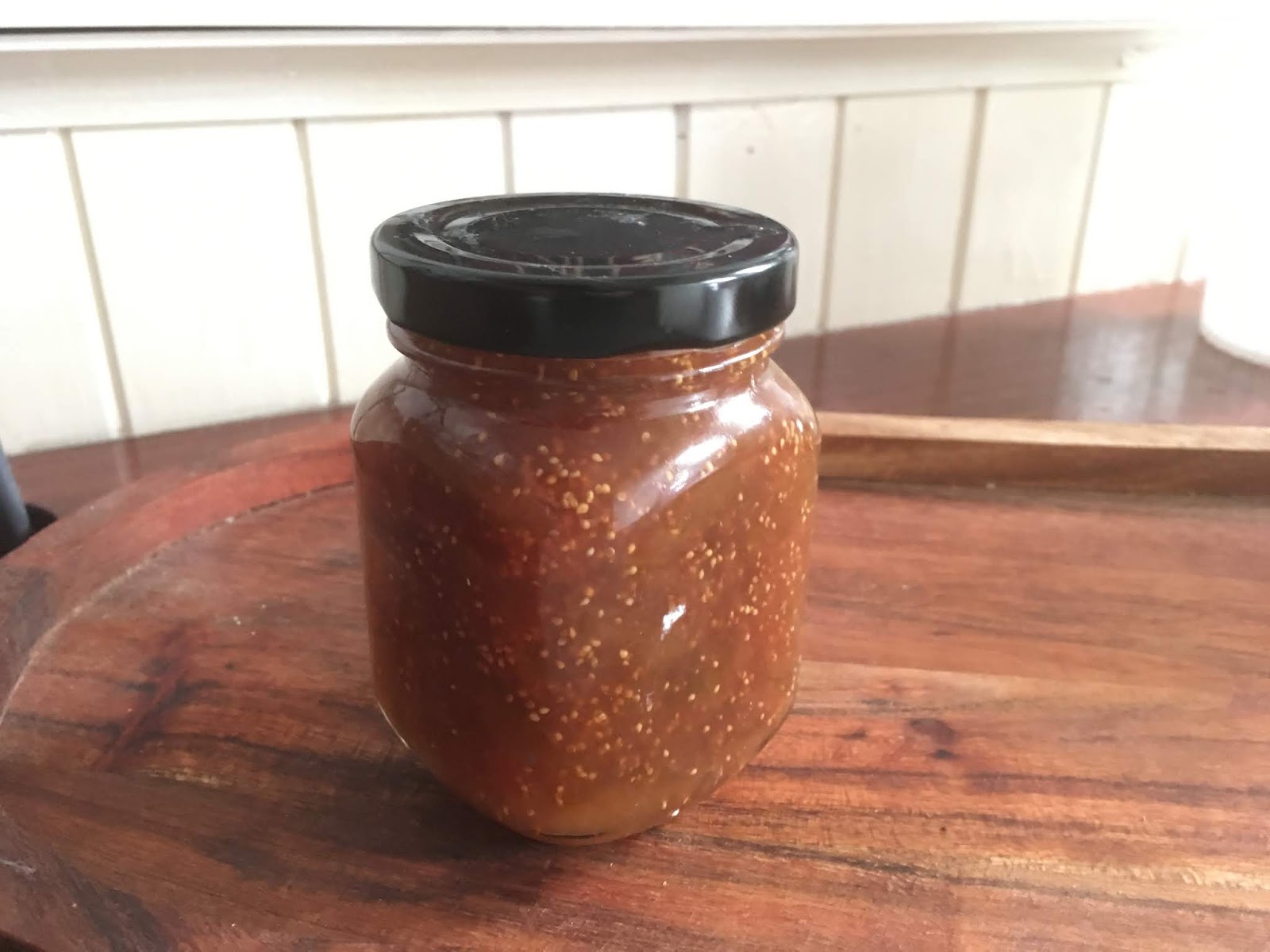
One of the people at DH's church gave him 3 kg of fresh figs, so he made fig jam too. There are also two bowls of fig and fennel paste to serve with cheese. We can use these for dinner parties and also as gifts.
The basil is growing well in the wicking styrofoam boxes so I am enjoying the summer tastes of tomatoes and basil. YUM
This week I started reading this book by Charles Massy called "The Call of the Reed Warbler". It is a book which will change your world view, especially if you care about growing your own food or having a sustainable earth. I got it from the library. I totally recommend it! It is very helpful to see the way in which farming (or gardening) involves whole ecosystems. If we can work with nature we will do better as will the planet we live on.
In my walks around the suburb, I often admire the trees, especially the oldest ones which must have been here before the suburb was developed in the 1970s. This one has a stump in the centre, with a bird hollow wired into it. The birds have been interesting this week: all of a sudden the crows have started calling again after a few silent months. We have been visited by black cockatoos who come to the pine tree in our neighbour's yard. There have also been white cockatoos feeding on the white gums which are flowering along the valley. We are in Bunuru-the Noongar people's name for this 'second summer' season which is also a time of the white flowers with lots of white flowering gums in full bloom, including Jarrah, Marri and Ghost Gums.
We are considering ripping up some of the bricks which we laid down about 10 years ago to cover the piece of land which is between our property line and the street (we call it here the 'verge' but in Victoria it was the 'nature strip". I am thinking it would be great to grow some low-growing native plants for the birds and insects. I must check the Council regulations, as there are very strict rules on what can and cannot be done on this part of the public land in our Council. Anyway, that won't be until later in the year as we need to wait until the winter rains come before planting any new gardens.
Labels:
cooking,
garden,
gardening,
Gardening recycling sustainable,
projects,
Quilt,
quilting,
Simple living
Monday, February 11, 2019
Showers of blessings
I found this 'golden showers' tree on my walk yesterday afternoon. So stunning that I had to stop and take a photo to share. The neighbour saw me and we had a nice chat about this tree, and how we all want one just like this!
It was an eventful week for me last week -my routine was completely upturned by the need to consult our GP who then ordered a battery of tests, which took all week to complete. Blood tests, ECG, CAT scan and bone scan in rapid succession! So far I seem to be remarkably healthy according to these tests, so of course there are more to come, as we try to find out what sparked the problem and if it is important. I am reminded yet again how remarkable our health system is, when it is working like this -quickly and compassionately. It was a bit stressful -made even more so when I broke a tooth and needed a filling too, as I
Perhaps these characters had something to do with my good fortune? We went to have a quick dinner in Northbridge on Friday, before a show, and were randomly placed right in the front row for the dragon dance for Chinese New Year. The dragons showered us with shredded lettuce they had eaten -apparently we are now expected to have rampant good fortune in the Year of the Pig.
The reason I was out walking yesterday was that I was visiting our Street Pantry. It is being used and is doing well! It has filled up several times -and emptied too- good to see it being used, and people being so generous.
These remarkable things are the red caps of Eucalyptus erythrocorys, commonly known as Illyarrie, Red-capped gum or Helmet nut gum, which is always in flower at this time of the year. The red caps fall off and the bright yellow flowers appear. DD used to collect the red caps in her uniform pocket on the way to primary school- a memory I will always associate with these flowers.
We were moved by the stunning Boorna Waanginy (Let the Trees speak) light and sound show at Kings Park on Sunday night. It was such a stunning portrayal of the love of First Nation people for this fragile land, and. a plea that we listen to their wisdom in taking care of it. This display of seed pods and stories of people-faces beamed onto the screen in the centre) committing themselves to care for our environment (was inspired.They each chose a 'totem' to take particular care of. I think my totem is the Illyarrie.
At home we have been doing some preserving. DH made some fig jam with figs which someone gave to us, and also made a fig and fennel paste to serve with cheese. They smelled fabulous when they were cooking.
So that is it for me this week. I have more tests to come, but life is good, isn't it?
Labels:
cooking,
inspiration,
Simple living,
wildflowers
Sunday, February 3, 2019
Community and many other wonderful things
A group of local people have started a Street Pantry in our suburb. The local Anglican church has allowed us to set it up on the verandah of their church, and the local MP gave us the cupboard. I am helping the group.
We have a closed FaceBook group with lovely generous members, who have provided enough food to fill this cupboard -more than 140 people are members of the group. We have non-perishables including toiletries.
This week we are going to tell some of the agencies and professionals who may come in contact with people who are struggling, as we hope that they will come and help themselves when in need.
In way this should not be necessary, but with welfare payments so low, and people having payments cut off for no reason, we do need it.
In fact, it has been quite a week for community serendipity. We were given two of these books at Christmas, so I offered on on the local Buy Nothing group.
A neighbour found out I collected cornucopia vases, and gave me this lovely glass one in a pretty pink. Just great for a few roses, which is all I have in the garden at the moment.
The park home had some pieces of furniture in it, which we don't need, so we have been offering them on the Buy Nothing group. It is so nice to meet the neighbours this way.
I did save one piece of furniture - a chair which I have placed in the sewing room. Dora thinks it is hers! I got quite active about tidying up in there, and have made more room for useful things. I want to keep this room actively useful, not just for storing things 'in case'. I want it to be nice to work in, a pleasant place. This chair is for the times when DH comes over from his study and we chat together!
I made some beetroot relish, and also some lemon and passionfruit cordial. I harvested a few grapes from one of the vines, but the grapes haven't been great this year. We think we will need to do some work on the reticulation in autumn -there doesn't seem to have been enough water for the fruit as they are splitting before they are ripe.
I have been working in a patchy fashion (hah!) on my quilt. I spread the blocks on the bed and realised that I was going to need to have a border on this one. That will keep me busy for a while!
Labels:
community,
cooking,
craft,
Simple living,
slow living
Subscribe to:
Posts (Atom)